
Introduction
The 3 of Swords is one of those cards that evokes disappointment in us whenever we see it in a spread. It really doesn't need much explanation as to what it means but it does raise some very deep questions, which are certainly worth exploring for personal development, when this card comes calling.
Our feelings are a tool but they are not who, or what, we are. The next time you feel something strongly, stop and take a moment to quieten your thoughts. Then retrace the origin of those feelings. Where did they come from? What caused them to rise up within you? Was it a new piece of information or was it your mind reliving some past event. Or did you imagine a scenario in the future and react to something that hasn't happened and might never happen? Your emotions are almost entirely created, re-awakened or manifested by your mind and it's thoughts.
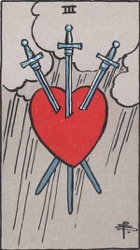
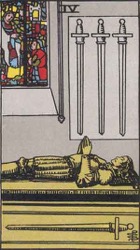
This is the core meaning of the 3 of Swords and why this emotional upset card is within the Suit of Swords and not in the Suit of Cups. It's an unusual card in that it strongly links emotions, which are part of the domain of the element of Water and the Suit of Cups, with the domain of the element of Air. In the Rider Waite Smith (RWS) deck this card is depicted as a heart pierced by 3 swords, with a grey cloud pouring rain as the background, in an almost a perfect mixture of Water and Air. The 3 of Swords reminds us of the origin of emotions and in particular the negative ones. If our thoughts control our emotions then we should be able to control our emotions by controlling our thoughts. Easy to say but, as with all spiritual practices, difficult to put into practice. It's not impossible though and this is why this card can become a very useful tool for self development and spiritual growth. In the next card in this Suit, the 4 Of Swords, we can see this in practice. In the RWS deck 3 Swords can be seen on the wall above the resting, recovering and meditating warrior. This is why spiritual practices, and prayer, focus on quietening the mind. A silenced mind allows emotions to become subdued, less acute, giving relief from the relentless pain they inflict upon us.
The 3 of Swords illustration in the Rider Waite Smith deck is unusual because unlike the original images and themes Smith and Waite added to the minor pip cards this card is not their original work but a copy. The oldest known 78 card Tarot deck is the Sola Busca Tarot which features a 3 of Swords depicted as a heart with 3 swords piercing it. It is possible that Smith and Waite did this to acknowledge Tarot's earliest origins and a previous attempt at having a fully illustrated 78 card deck.
The 3 of Swords is a card of unhappiness, sorrow, tears and separation. The element here is Air which relates to challenges, conflicts and the mental aspects of our lives. The storms on the path of life that we have to navigate through. In numerology a number has positive, negative and destructive influences. The suite of Swords tends to focus on the negative and destructive. The negative aspects of the number 3 in numerology are worry, criticism, sadness, pain and disappointment.
© Phuture Me Ltd 2010-2019. All rights reserved.
3 of Swords in a Tarot Reading
The 3 of Swords describes emotional pain connected with thought, information or interpretation. A message may hurt, a memory may reopen sorrow or an imagined future may produce distress before anything has happened. The card asks how the feeling arose as well as what it feels like.
That connection explains its place among Swords rather than Cups. Air and Water meet in the image of the pierced heart and rain. This relationship invites you to observe thought more closely, without denying the reality of the pain it accompanies.
Upright Meaning
Upright, the 3 of Swords can indicate disappointment, separation or a painful understanding. Something you learn or conclude may change how you feel about a situation. The experience deserves care, while the conclusion itself may still need examining.
Distinguish new information from an old memory and from a feared possibility. All three can create a strong response, but they do not call for the same practical action. A remembered hurt cannot be resolved by accusing someone in the present of an event that has not occurred.
The card's connection with the 4 of Swords suggests the value of allowing mental space before continuing the argument or interpretation. This is not a demand to think pain away. It is a chance to notice whether additional thought is clarifying the experience or repeatedly intensifying it.
Upright keywords: heartache, disappointment, painful understanding, sorrow, separation, hurtful thoughts, emotional reaction, difficult information.
Reversed Meaning
Reversed, the 3 of Swords may indicate that the relationship between thought and feeling is becoming clearer. A painful interpretation may loosen, an old story may be reconsidered or a conversation may distinguish what was intended from what was understood.
Alternatively, hurt may remain unexpressed and repeatedly revisited internally. The reversal can also describe pressure to appear recovered before the experience has been acknowledged. A quieter outward presentation does not necessarily mean the pain has ended.
Context helps distinguish gradual release from concealed distress. Look for more accurate understanding and less compulsion to repeat the same hurtful account. The card does not promise that every painful fact can be changed, but the way it is carried may become different.
Reversed keywords: gradual release, reconsidered interpretations, unspoken hurt, revisited sorrow, emotional processing, lingering pain, clearer understanding.
Love and Relationships
In love, the 3 of Swords can describe a painful conversation, disappointment or the effect of interpreting a partner's words through an earlier hurt. It may accompany separation, but the image does not by itself prove betrayal or identify a third person.
Reversed, a more accurate conversation may help distinguish fact, intention and assumption. Alternatively, the hurt may be kept private while resentment grows. Explain the particular event and response rather than treating the feeling as evidence that every feared conclusion must be true.
Work and Career
At work, this card can concern criticism, a rejection or information that feels personally painful. The practical message may be difficult to hear because it becomes entangled with a wider judgement about your ability or worth. Separate the specific feedback from that larger conclusion.
Reversed, useful points may become easier to recognise after the first reaction, or a discouraging interpretation may persist without being checked. Seek clarity where a message is ambiguous. A difficult result can inform the work without defining the whole of your professional future.
Money and Finances
For finances, the 3 of Swords may describe disappointment attached to a result, expense or decision. The material event and the meaning you give it can both contribute to the emotional response. A setback may be interpreted as evidence of permanent failure when the facts are narrower.
Reversed, a clearer assessment may reduce that added burden, or shame may keep the issue unspoken. Review what actually happened and what remains possible. The card concerns the pain surrounding the matter rather than providing a forecast of a particular financial loss.
Advice from the 3 of Swords
Trace the feeling back to its immediate source with kindness. Identify whether you are responding to information, memory or imagination, and choose the next step accordingly. Give yourself enough space that a painful thought does not have to become the final explanation of the whole situation.
Ask yourself: What thought or information is this pain responding to, and have I understood it accurately?
The 3 of Swords opens a difficult but useful distinction between what hurts and the story through which that hurt is understood.
© Phuture Me Ltd 2026. All rights reserved.
3 of Swords According to A. E. Waite
The Pictorial Key to the Tarot
Arthur Edward Waite (1911)
Three swords piercing a heart; cloud and rain behind. Divinatory Meanings: Removal, absence, delay, division, rupture, dispersion, and all that the design signifies naturally, being too simple and obvious to call for specific enumeration. Reversed: Mental alienation, error, loss, distraction, disorder, confusion.
Related Tarot Cards
 |
 |
 |
© Phuture Me Ltd 2019. All rights reserved.
 Tarot & Numerology