
Introduction
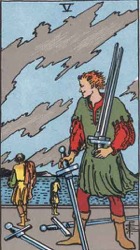
The 5 of Swords is a card of an empty and pointless victory, embarrassing or humiliating situations, quarrels and even violence. 5s are never welcome cards in any tarot reading and Swords are often troublesome. This card especially is a warning not to be taken lightly. In the Rider Waite Smith (RWS) deck the imagery is one of the aftermath of a battle. The victor picking at the remains. The defeated have turned their backs and walked away. This is a man without friends. There's no real prize here for anyone and the bleak landscape and grey sky sums up the mood of despair for all. What was the purpose of the fight? To strengthen an ego hell bent on it's desperate need to be right? The pitfall of being viewed as sanctimonious? This tragedy could have been avoided through diplomacy, listening to what others have to say, accepting differing opinions and searching for, and reaching, common ground.
The RWS 5 of Swords scene is the aftermath of a quarrel with one person looking very self satisfied and the other two, backs turned, leaving the scene. There are no friends here, no unity, only loneliness and despair. Too often we allow our views of the world, our identities, our religious or political beliefs to drive a wedge between us. By placing less value and priority on these abstract mental constructs we can build bridges between us and create harmony for all.
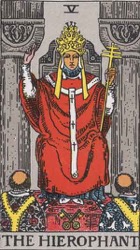
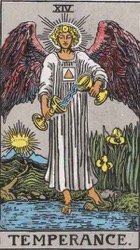
All the cards in the Minor Arcana numbered 5 are problematic cards. The number 5, in numerology, has the negative qualities of being chaotic, unstable, self-indulgent, irresponsible or careless and Tarot's Minor 5s reflect those negatives. If we look to the 5s in the Major Arcana we find positive cards which offer a solution to this chaos. Card number 5 of the Major Arcana is The Hierophant which represents conformity, doctrine, laws and rules that bring order from chaos. It represents not just the church and religious law but all establishments of authority which people live and work under. The other 5 in the Major Arcana is card number 14 Temperance (numerology reduces 14 to 5) which represents self control. When dealing with the 5 of Swords in a Tarot spread these additional cards maybe the warning, or the solution, of what sort of control will be applied to the unruly behaviour of this card. External control or self control.
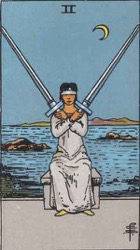
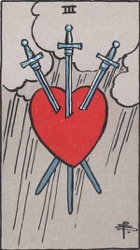
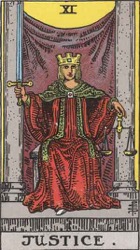
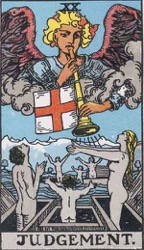
The central character in the RWS 5 of Swords holds 3 swords symbolising the numerological link to the 3 Of Swords, the card of despair and heart ache. The 2 remaining swords on the ground are a numerological link to the 2 Of Swords symbolising the ignored diplomatic option which could have prevented this situation from occurring. They also serve as a link to Judgement and Justice in the Major Arcana. Both cards have numerological values of 2 and this symbolic connection may carry a warning of the consequences of his actions.
The Suit of Swords, representing the Element of Air, symbolises the mental and intellectual aspects of life. The storms on the path of life that we have to apply our minds and intelligence to navigate through. Like the steel in the sword we are tempered by the hammer and flames of life's challenges and trials. The negative characteristics and meaning of the number 5, in numerology, are instability, chaos, self-indulgence, irresponsibility, procrastination, thoughtlessness and carelessness. This combination of element and numerology would suggest not focusing on doing one thing well but many things badly. Not thinking things through properly and being forceful in gaining the upper hand, or short term victory, only for it to later turn against you into isolation, defeat and humiliation.
© Phuture Me Ltd 2010-2019. All rights reserved.
5 of Swords in a Tarot Reading
The 5 of Swords asks what has been won when a conflict leaves people divided and unwilling to cooperate. The apparent victor may hold the swords, but the scene offers little shared value. An argument can be technically won while the purpose for having it is lost.
The three gathered swords link with hurt, while the two abandoned swords suggest the diplomatic option that was ignored. The card therefore concerns both the cost of forceful victory and the possibility that a different method could have prevented that cost.
Upright Meaning
Upright, the 5 of Swords can indicate a quarrel in which being right becomes more important than reaching a useful understanding. Identity, pride or a strongly held view may make compromise feel unacceptable. The result can be humiliation or isolation rather than a workable resolution.
The number 5 brings instability and careless self-interest to Air. Thought can become a weapon used to gain the upper hand, with too little attention to what happens after the immediate exchange. The person who withdraws is not necessarily the person who has understood the situation least well.
External boundaries or internal restraint can offer possible responses. Rules may be needed where behaviour has become unacceptable, while self-control can prevent a disagreement from becoming a contest whose only purpose is domination.
Upright keywords: hollow victory, destructive argument, humiliation, ego conflict, lost cooperation, forceful advantage, careless reasoning, isolation.
Reversed Meaning
Reversed, the 5 of Swords can suggest a willingness to stop the contest and examine its cost. Someone may step away, acknowledge harm or seek a more constructive form of discussion. A useful change requires more than declaring the argument finished while preserving the same attitude.
Alternatively, resentment may continue beneath a quieter surface. The open conflict can end without the underlying wish to win disappearing. The reversal may also indicate repeated efforts to reopen a quarrel that no longer serves anyone.
Context helps distinguish de-escalation from suppressed hostility. Ask whether behaviour and expectations have changed enough for cooperation to resume. Where they have not, a clear boundary may be more realistic than demanding immediate harmony.
Reversed keywords: de-escalation, lingering resentment, reconsidered victory, unresolved hostility, attempted repair, withdrawal from conflict, repeated quarrels.
Love and Relationships
In relationships, the 5 of Swords can describe arguments conducted to defeat rather than understand a partner. Cleverness, old mistakes or sensitive information may be used to strengthen a position. Even a successful argument can leave the bond less safe for honest conversation.
Reversed, a couple may begin recognising the pattern or remain caught in its aftermath. Focus on how disagreement is handled, not only on which person has the stronger case. The card does not require accepting harmful behaviour in the name of compromise; respectful boundaries are part of preventing further damage.
Work and Career
At work, this card can indicate competitive behaviour that damages the team, public embarrassment or a dispute in which reputation matters more than solving the problem. A short-term advantage may create longer-term resistance from people whose cooperation is still needed.
Reversed, a team may choose a clearer process for disagreement, or the conflict may move into indirect retaliation. Keep decisions tied to evidence and shared objectives. A useful outcome should leave the work more possible, rather than merely establish who can exert the most pressure.
Money and Finances
For finances, the 5 of Swords can concern a dispute in which the effort to prevail begins exceeding the practical value of the issue. Pride may make it difficult to recognise the cost in time, stress or damaged relationships. That cost belongs in the assessment.
Reversed, a more proportionate discussion may become possible, or an old financial quarrel may keep returning. Clarify the concrete matter and the terms of any resolution. The card asks about the method and consequences of conflict, not who will win a legal or financial claim.
Advice from the 5 of Swords
Define the outcome that would actually be useful. If winning the argument would destroy that outcome, change the method or leave the contest where appropriate. Listen for what can be understood without treating every concession as a loss of identity.
Ask yourself: If I win this exchange, what will remain that makes the victory worth having?
The 5 of Swords exposes the difference between gaining the upper hand and reaching a result that serves life afterwards.
© Phuture Me Ltd 2026. All rights reserved.
5 of Swords According to A. E. Waite
The Pictorial Key to the Tarot
Arthur Edward Waite (1911)
A disdainful man looks after two retreating and dejected figures. Their swords lie upon the ground. He carries two others on his left shoulder, and a third sword is in his right hand, point to earth. He is the master in possession of the field. Divinatory Meanings: Degradation, destruction, revocation, infamy, dishonour, loss, with the variants and analogues of these. Reversed: The same; burial and obsequies.
Related Tarot Cards
 |
 |
 |
 |
 |
 |
 |
 |
 |
© Phuture Me Ltd 2018. All rights reserved.
 Tarot & Numerology