
Introduction
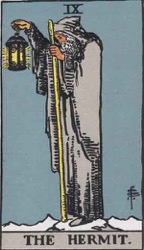
The Hermit is a card of retrospection, solitude and introspection. The imagery is often one of a cloaked old man, holding up a lantern, searching in the darkness of night. As the 9th card of the Major Arcana it is also about endings. This character is depicted in both the Marseilles and Rider Waite Smith (RWS) decks facing left which symbolises the past. Therefore The Hermit is specifically about retrospective searching. Arriving at the end of something, turning around and looking back to see if one can make any sense of it.
The name Hermit suggests being alone. Solitude is often required to remove other distractions around us so we may think clearly, contemplate, rest and plan ahead. The ground below his feet is often depicted as white with snow. Timing is a difficult art to master with Tarot and the appearance of The Hermit can sometimes point to the season of winter. In the RWS deck The Hermit holds up a lantern to light his path in a night time of total darkness. As The Moon features in a number RWS cards except this one its omission may be taken to imply that its scene is set on the night of a new moon. This can be another useful time marker to keep in mind.
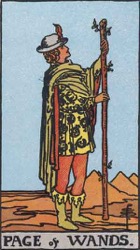
Pay close attention to the details of the imagery for The Hermit in your deck. The RWS deck has The Hermit looking down and facing left. His gaze is in the same direction as the Queen of Pentacles. This direction symbolises a mind focused on the past and material matters. There is another card in the RWS deck which is the exact opposite in almost every respect to The Hermit. That card is The Page of Wands. There are at least 8 opposite attributes between these cards. See if you can identify them as a useful exercise in recognising symbolic details.
 |
 |
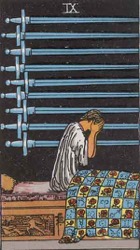
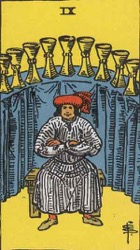
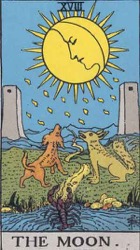
Numerology: The Hermit is card number 9 of the Major Arcana. This is the final number of the numerological sequence. All Tarot card's that have the number 9 have a theme of isolation or loneliness. This theme of an end of a cycle is seen in the winter landscape through which The Hermit walks. The number 9 is the number of a humanitarian. As a person it could symbolise someone who cares for the world and has cast aside personal ambitions, desires and material possessions. A priest, a monk, a spiritual teacher. An activist who cares about a cause. The other card in the Major Arcana which has a numerology of 9 is card 18 The Moon. Numerology reduces 18 to 9 (1+8=9). If you are attempting to divine timing using Tarot then The Moon would represent a full moon and The Hermit would be a good fit for a new moon as he is commonly depicted walking at night in total darkness which is why he carries a torch.
© Phuture Me Ltd 2010-2019. All rights reserved.
The Hermit in a Tarot Reading
The Hermit looks back to understand what has been lived. Its solitude serves retrospection: reaching the end of an experience, stepping away from distraction and asking what it means. This is a more specific activity than simply being alone or seeking unspecified wisdom.
The number 9 connects the card with the completion of a cycle. Attention turns towards what has accumulated through it, including lessons, losses and changes in priorities. The lantern offers enough light for careful examination, even when a complete view of the future is unavailable.
Upright Meaning
Upright, The Hermit can indicate a useful period of withdrawal from noise and expectation. A relationship, project or phase of life may need to be understood before you decide what comes next. Quiet gives the experience room to settle into knowledge.
The card can also represent a guide whose insight comes from reflection and experience rather than display. Such a person may help you ask a better question without claiming the right to choose your direction for you.
Its humanitarian aspect can bring attention to values beyond personal ambition. You may be reconsidering how much importance to give possessions, recognition or the goals that once occupied you. The aim is not to dismiss ordinary life, but to understand which parts still deserve your energy after what you have learned.
Upright keywords: retrospection, solitude, contemplation, experience, endings, guidance, reflection, reconsidered priorities, inner searching.
Reversed Meaning
Reversed, The Hermit can describe reflection becoming repetitive isolation. Looking back may no longer produce understanding if the same regrets are examined without a new perspective or any contact with present life. Solitude can stop serving its original purpose.
Alternatively, you may be avoiding the quiet required to process an experience. Constant activity or other people's opinions can prevent you hearing what you actually think. Surrounding cards help distinguish too much withdrawal from too little space for reflection.
The reversal can also mark readiness to return from a useful retreat. The important measure is whether the time alone has clarified something you can now carry into ordinary relationships and decisions.
Reversed keywords: isolation, rumination, avoided reflection, loneliness, excessive withdrawal, unprocessed experience, returning to engagement.
Love and Relationships
In love, The Hermit may indicate a need to understand your own experience before making another commitment or resolving a recurring issue. Time apart can be useful when its purpose is clear and it is not used to leave the other person guessing indefinitely.
For someone single, the card may concern learning from previous relationships rather than treating being alone as a failure. Reversed, old disappointments can become a reason never to engage again. Equally, moving immediately into a new connection may prevent the reflection that would help you choose differently.
Work and Career
At work, The Hermit can suggest reviewing a completed project, reassessing a career stage or seeking experienced guidance. What has the work taught you, and does the next goal still make sense? A quieter period can reveal a mismatch between outward success and present values.
Reversed, reviewing may become an endless substitute for choosing, or a busy schedule may prevent any useful assessment. Make the reflection specific enough to inform a decision. Experience has practical value when it changes how you approach the next piece of work.
Money and Finances
For finances, The Hermit can concern stepping back from comparison and examining what material security means to you. A review of previous choices may show that some expenses supported your values while others followed expectations you no longer share.
Reversed, worry about earlier mistakes may dominate present decisions, or financial matters may be left unexamined because they are uncomfortable. Use records and current circumstances to keep reflection grounded. The aim is a clearer relationship with resources, not self-punishment for every imperfect choice.
Advice from The Hermit
Give a completed experience the attention needed to understand it. Ask what has changed in you, rather than only whether the outcome was successful. Then notice when reflection has given you enough light to rejoin life with a clearer sense of direction.
Ask yourself: What does this finished chapter teach me about the life I want to live next?
The Hermit's solitude is fruitful when looking back helps you return to the present with understanding.
© Phuture Me Ltd 2026. All rights reserved.
The Hermit According to A. E. Waite
The Pictorial Key to the Tarot
Arthur Edward Waite (1911)
The variation from the conventional models in this card is only that the lamp is not enveloped partially in the mantle of its bearer, who blends the idea of the Ancient of Days with the Light of the World It is a star which shines in the lantern. I have said that this is a card of attainment, and to extend this conception the figure is seen holding up his beacon on an eminence. Therefore the Hermit is not, as Court de Gebelin explained, a wise man in search of truth and justice; nor is he, as a later explanation proposes, an especial example of experience. His beacon intimates that "where I am, you also may be."
It is further a card which is understood quite incorrectly when it is connected with the idea of occult isolation, as the protection of personal magnetism against admixture. This is one of the frivolous renderings which we owe to Éliphas Lévi. It has been adopted by the French Order of Martinism and some of us have heard a great deal of the Silent and Unknown Philosophy enveloped by his mantle from the knowledge of the profane. In true Martinism, the significance of the term Philosophe inconnu was of another order. It did not refer to the intended concealment of the Instituted Mysteries, much less of their substitutes, but--like the card itself--to the truth that the Divine Mysteries secure their own protection from those who are unprepared.
Related Tarot Cards
 |
 |
 |
 |
|
 |
© Phuture Me Ltd 2019. All rights reserved.
 Tarot & Numerology