
Introduction
The Tower has a complex and varied history in its depictions from the early days of tarot to the present day as well as in the mythology behind those many depictions. The biblical Tower of Babel is one of many mythological man made constructions that were fabled to have been built in an attempt to reach heaven and God(s). Nearly every ancient culture has a comparable myth from the far east to Africa and central and south Americas. If there is a common moral to each of these myths, which relates to the meaning of this card, it is that those who are arrogant enough to believe they can stand high on their own constructions and reach heaven, or know God, will eventually fail and fall.
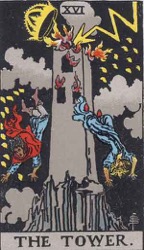
The Tower of the myths is a physical construction but The Tower in tarot is more often a metaphor for beliefs that we hold in high regard or that make us think we know best. It can be a card that warns us of being sanctimonious. Everyone has their own set of beliefs that they hold to be true because they are part of our identity, or because we have been taught them at school or church or through reaching our own conclusions. Those beliefs are sometimes tested and, like the lightning bolt striking The Tower, they crumble and fall. In a more positive light this card may have the meaning of testing a hypothesis. We make an assumption on limited data and then test it to see if it fails or holds firm. Mistakes are one of the greatest teachers we can learn from but too often the fear of failure keeps us from that class room. This is the core meaning of The Fool, which urges us to take a risk. In contrast The Tower pushes us off the edge unwillingly.
In Tarot The Tower is card number 16 of the Major Arcana which numerology reduces to 7 (1 + 6). The number 7 is the number of rest, inaction, study, introspection, research and spiritual life. The major religions of the world all have a day of rest and prayer on their 7th day. The Tower represents the negative characteristics of the 7, ignoring its restful nature and trying to commune with God via other unnatural or man made methods. The number 7 symbolises the search for God, faith or spiritual enlightenment. Sometimes spiritual awakening is forced upon us through traumatic, or unexpected, events and changes in our life. A near death experience, the loss of a loved one or some sudden change that shakes us out of our routines and beliefs to what is most important in life. The card following The Tower is The Star, the card that is symbolic of spiritual enlightenment.
The Tower is the card of false beliefs, sudden changes, nasty surprises, unexpected events or natural disasters. This card maybe a warning of pride coming before a fall. How long can someone ignore the real truth before it brings them, and their beliefs, crashing down to earth? The appearance of The Tower will more commonly signify that an assumption or belief is about to be proven incorrect. It can occasionally be literal and warn of damage to the home from adverse weather or relate to the home more metaphorically like unexpectedly losing the lease on a rented home and having to find another.
© Phuture Me Ltd 2010-2019. All rights reserved.
The Tower in a Tarot Reading
The Tower challenges a structure built on an assumption that may not withstand reality. That structure can be a belief, expectation or arrangement you have come to rely upon. The card's dramatic image reflects the shock of discovering that certainty was less secure than it appeared.
Its meaning is therefore broader than disaster. A hypothesis being tested, an error becoming visible or an event overturning a familiar explanation can all belong here. What matters is the contact between the construction and something it cannot successfully accommodate.
Upright Meaning
Upright, The Tower can indicate an abrupt correction to what you thought you knew. Information or events may make an old position impossible to maintain. The disruption can feel personal when the belief has become part of your identity or status.
The card asks you to examine the foundation rather than defend the height of the construction. Was the arrangement based on incomplete information, an untested expectation or the conviction that ordinary limits did not apply? A failed assumption can teach something essential even when the lesson arrives unwelcome.
Not every appearance predicts a major external crisis. The subject and surrounding cards determine the scale. In a modest question, The Tower may simply describe a plan that needs substantial revision once its weak point is exposed.
Upright keywords: challenged assumptions, sudden correction, disruption, exposed weakness, unexpected change, failed certainty, revelation, rebuilding.
Reversed Meaning
Reversed, The Tower can suggest resistance to evidence that a structure needs changing. Considerable effort may go into protecting appearances or explaining away each warning, leaving the underlying weakness untouched. Delay can increase the cost of an eventual correction.
Alternatively, the card can describe a quieter internal revision or the aftermath of a disruption. You may already know that the former explanation no longer works and be deciding what can be rebuilt more honestly. Context helps distinguish avoidance from recovery.
The reversal does not guarantee that a crisis has been prevented. Its useful question is whether the information now available is changing the way you proceed. A smaller, deliberate revision can sometimes replace the need to defend an increasingly unsound position.
Reversed keywords: resisted change, ignored evidence, internal upheaval, prolonged instability, reassessment, aftermath, reluctant rebuilding.
Love and Relationships
In love, The Tower can describe discovering that an assumption about the relationship was inaccurate. Expectations about commitment, trust or a shared future may need to be discussed anew. The revelation can concern a misunderstanding as well as a more serious breach.
The card alone does not establish betrayal or require a separation. Reversed, a couple may avoid an issue because acknowledging it would change their familiar arrangement. Alternatively, they may be rebuilding after it has already emerged. Repair depends on understanding what failed rather than restoring the old appearance at any cost.
Work and Career
At work, The Tower may indicate a plan, strategy or organisational assumption being tested and found wanting. A project can fail because a crucial condition was never established, while a role may change abruptly when a larger structure is revised.
Reversed, warning signs may be dismissed because too much prestige or previous effort is attached to the plan. It can also describe the difficult work of reconstructing a more realistic approach. Separate the value of the people involved from the validity of the assumption that failed.
Money and Finances
For financial questions, The Tower can concern an unexpected cost or the discovery that an arrangement is less secure than believed. Its focus is the weakness exposed by the event. Understanding that weakness matters more than treating the shock as proof that nothing can ever be trusted.
Reversed, uncertainty may be concealed or a correction postponed. Alternatively, you may be rebuilding after a material setback. Check the actual conditions and commitments before attempting to restore the previous position. The card is symbolic, not a prediction of a particular financial disaster.
Advice from The Tower
Test the belief you most want to protect. If new information contradicts it, revise the structure around that information rather than forcing the evidence to fit. Acknowledging a mistake can preserve the capacity to build something more sound.
Ask yourself: Which assumption am I defending because of what it means to me rather than because it still holds up?
The Tower's difficult gift is the opportunity to replace unsupported certainty with a firmer understanding.
© Phuture Me Ltd 2026. All rights reserved.
The Tower According to A. E. Waite
The Pictorial Key to the Tarot
Arthur Edward Waite (1911)
Occult explanations attached to this card are meagre and mostly disconcerting. It is idle to indicate that it depicts min in all its aspects, because it bears this evidence on the surface. It is said further that it contains the first allusion to a material building, but I do not conceive that the Tower is more or less material than the pillars which we have met with in three previous cases. I see nothing to warrant Papus in supposing that it is literally the fall of Adam, but there is more in favour of his alternative--that it signifies the materialization of the spiritual word. The bibliographer Christian imagines that it is the downfall of the mind, seeking to penetrate the mystery of God. I agree rather with Grand Orient that it is the ruin of the House of We, when evil has prevailed therein, and above all that it is the rending of a House of Doctrine. I understand that the reference is, however, to a House of Falsehood. It illustrates also in the most comprehensive way the old truth that "except the Lord build the house, they labour in vain that build it."
There is a sense in which the catastrophe is a reflection from the previous card, but not on the side of the symbolism which I have tried to indicate therein. It is more correctly a question of analogy; one is concerned with the fall into the material and animal state, while the other signifies destruction on the intellectual side. The Tower has been spoken of as the chastisement of pride and the intellect overwhelmed in the attempt to penetrate the Mystery of God; but in neither case do these explanations account for the two persons who are the living sufferers. The one is the literal word made void and the other its false interpretation. In yet a deeper sense, it may signify also the end of a dispensation, but there is no possibility here for the consideration of this involved question.
 Tarot & Numerology