
Introduction
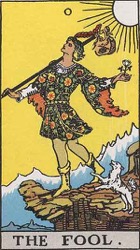
The Fool is probably the most misunderstood but certainly the most important card in the Tarot deck. In the Rider Waite Smith deck, Arthur E. Waite and Pamela Coleman Smith's Fool is illustrated in a way that leaves The Fool's next step open to interpretation. Most who see this card just take his name and, as the human mind is so good at, fill in what's not there. A cliff and unheeded disaster. But is it a cliff? Could it just be a ledge? Is the dog trying to warn him, or is it just happy and carefree like its companion who is looking towards the heavens. The dog too appears, on closer inspection, to be looking in the same direction. Neither traveler is concerned with the ground falling away in front of them.
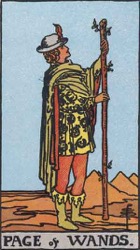
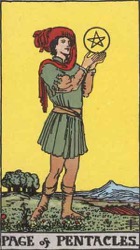
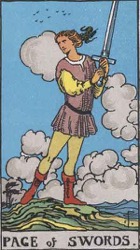
The Fool is related to the Pages in the Minor Arcana suits. Each minor page relates to a naive, or foolish, approach to their element. The Fool, just like the other Major courtiers (The Chariot, The Empress and The Emperor ), is a master of all the elements with a focus on the spiritual realm. He walks left, towards the past, which is symbolic of the wrong direction. Beautifully dressed he looks as if he has set out on an adventure in search for something. His focus on heaven symbolises his search for a meaning to life, a higher purpose and destiny. His intentions are good but he lacks experience and wisdom and may be going in the wrong direction. The imagery of The Fool asks a question of us. Who are we to look at someone else and think that they are going in the wrong direction? If their intentions are good, and they are following their heart not their head, how can they be wrong? The following 21 cards in the Major Arcana each symbolise the mysteries The Fool must solve, and lessons he must learn, once he finds the life path he must follow that will guide him to what he is looking for.
The Fool is unique among the Major Arcana for being the only card not to have a number. However some Tarot decks give this card a numerical value of 0 (zero). There is no numerology to constrain The Fool and he, and the Pages, are unique in being free from its cycle of numbers. The Fool represents an individual's journey through the trials of life, marked out by each of the 21 Major Arcana cards, ending with the Ascension to Enlightenment in the final card, The World.
Sometimes we need to follow our hearts not our heads or the perceived wisdom of others and trust in our own intuition.
“Your time is limited, so don’t waste it living someone else’s life.
Don’t be trapped by dogma, which is living with the result of other people’s thinking.
Don’t let the noise of other’s opinions drown out your own inner voice.
And most important, have the courage to follow your heart and intuition.
They somehow already know what you truly want to become.
Everything else is secondary.
Stay Hungry, Stay Foolish ”
- Steve Jobs, 2005 Stanford Commencement Address.
© Phuture Me Ltd 2010-2018. All rights reserved.
The Fool in a Tarot Reading
The Fool represents the individual setting out in search of meaning without already possessing the wisdom the journey will bring. Good intentions, curiosity and an inner sense of direction may be present even when experience is limited. The next step remains open to interpretation.
The open-ended image challenges the assumption that the figure must be heading towards disaster. A reader can mistake unfamiliar choices for foolish ones. The card therefore asks both how you approach your own path and how readily you judge a path that makes little sense from the outside.
Upright Meaning
Upright, The Fool can indicate a beginning guided by curiosity, intuition or the wish to live more authentically. You may feel drawn towards an experience before you can explain exactly where it will lead. The value lies partly in what can only be learned by participating.
Its relationship with the Pages reinforces openness and inexperience, but its scope includes the whole person rather than one elemental area. A change may challenge your ideas, attachments, ambitions and practical habits together.
The card does not require abandoning judgement. It suggests leaving room for a possibility that established expectations cannot fully describe. Listening to advice and examining practical circumstances can coexist with recognising that someone else's preferred life may not be yours. Beginning is an act of discovery, not a claim that you already know everything.
Upright keywords: openness, personal journey, beginnings, curiosity, innocence, intuition, exploration, freedom, learning through experience.
Reversed Meaning
Reversed, The Fool may indicate inexperience that is not being acknowledged. Enthusiasm can make it easy to overlook a relevant detail or assume that good intentions will resolve every difficulty. Pause long enough to understand the actual next step rather than an imagined adventure.
Alternatively, fear of appearing foolish may prevent any beginning at all. You might keep seeking permission from people whose values differ from your own. Surrounding cards help distinguish a useful warning from the self-doubt that makes every unfamiliar path seem unacceptable.
Both expressions concern the relationship between openness and awareness. The response is neither automatic caution nor automatic risk-taking, but a more honest understanding of what draws you forward and what you still need to learn.
Reversed keywords: unexamined risk, inexperience, hesitation, fear of judgement, avoidance of learning, misplaced trust, inhibited beginnings.
Love and Relationships
In love, The Fool can describe approaching a connection with openness rather than imposing a complete story on it immediately. There may be pleasure in discovering another person without knowing what the relationship will become. A fresh approach can also enliven an established partnership.
Reversed, one person may assume that attraction removes the need to discuss expectations, or fear of disappointment may prevent genuine engagement. Let the connection develop through actual experience. Neither a carefree manner nor an unconventional beginning establishes whether someone can meet your needs over time.
Work and Career
At work, The Fool may represent entering an unfamiliar field, learning a role or pursuing work that feels personally meaningful. Being a beginner can be productive when you are willing to ask questions and gain experience rather than defend an appearance of expertise.
Reversed, enthusiasm may outrun preparation, or concern about status may stop you accepting the learning involved in a new direction. Identify the first practical experiment you can make. You need not know the whole career path to discover whether the next stage teaches you something useful.
Money and Finances
For financial questions, The Fool can describe unfamiliar responsibilities or the material consequences of a new direction. Freedom may be important, but so is understanding what the next step requires. Curiosity works better when the commitments attached to it are visible.
Reversed, an appealing possibility may be accepted without enough attention to its terms, or fear may make any change feel impossible. Separate what you know from what you are hoping. The card invites exploration; it does not establish that a financial risk will be rewarded.
Advice from The Fool
Listen for your own reasons beneath the noise of other people's expectations. Then approach the next step with the willingness to learn that makes a beginner's openness valuable. You can trust your search without pretending you already know its destination.
Ask yourself: Is this the path I want to explore, and what am I willing to learn by taking its next step?
The Fool's journey becomes yours when curiosity is joined by responsibility for the experience you choose.
© Phuture Me Ltd 2026. All rights reserved.
The Fool According to A. E. Waite
The Pictorial Key to the Tarot
Arthur Edward Waite (1911)
With light step, as if earth and its trammels had little power to restrain him, a young man in gorgeous vestments pauses at the brink of a precipice among the great heights of the world; he surveys the blue distance before him-its expanse of sky rather than the prospect below. His act of eager walking is still indicated, though he is stationary at the given moment; his dog is still bounding. The edge which opens on the depth has no terror; it is as if angels were waiting to uphold him, if it came about that he leaped from the height. His countenance is full of intelligence and expectant dream. He has a rose in one hand and in the other a costly wand, from which depends over his right shoulder a wallet curiously embroidered. He is a prince of the other world on his travels through this one-all amidst the morning glory, in the keen air. The sun, which shines behind him, knows whence he came, whither he is going, and how he will return by another path after many days. He is the spirit in search of experience. Many symbols of the Instituted Mysteries are summarized in this card, which reverses, under high warrants, all the confusions that have preceded it.
In his Manual of Cartomancy, Grand Orient has a curious suggestion of the office of Mystic Fool, as apart of his process in higher divination; but it might call for more than ordinary gifts to put it into operation. We shall see how the card fares according to the common arts of fortune-telling, and it will be an example, to those who can discern, of the fact, otherwise so evident, that the Trumps Major had no place originally in the arts of psychic gambling, when cards are used as the counters and pretexts. Of the circumstances under which this art arose we know, however, very little. The conventional explanations say that the Fool signifies the flesh, the sensitive life, and by a peculiar satire its subsidiary name was at one time the alchemist, as depicting folly at the most insensate stage.
Related Tarot Cards
 |
 |
 |
 |
 Tarot & Numerology