
Introduction
At the beginning of the 20th century Tarot went through a revolutionary change with the publication of the Rider Waite Smith (RWS) tarot deck. Up until this point the most popular Tarot decks had followed a structure and format based on the Marseilles Tarot. The cards in the Minor Arcana had no pictures and were closer to playing cards with pips than to the fully illustrated deck of cards that the RWS deck introduced. In addition to this radical evolution Waite and Smith also swapped the positions of two of the Major Arcana cards. Traditionally Strength was card 11 and Justice was card 8.
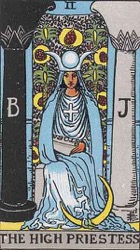
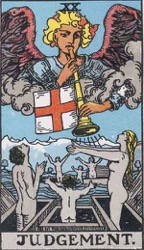
The majority of modern Tarot decks have continued with this modification to the Major Arcana even though the reason Waite gave, in his description of Strength, was "for reasons that satisfy myself" which doesn't give much insight as to why it was so important to him or Pamela Smith. Tarot has a well ordered structure based on the symbolism of the classical elements and numerology. The 8th card of the Major Arcana, according to the symbology of numerology, should have a meaning and interpretation of power and control. For this reason Strength is numerologically better suited to position 8 than Justice. Giving Justice number 11, which reduces to 2 in numerology (1+1=2), relates it directly to all the other cards with a numerology of 2 including The High Priestess and Judgement. The number 2, in numerology, represents balance, diplomacy and fairness. Swapping these cards corrected and improved the overall structure of Tarot significantly.
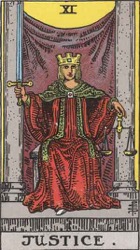
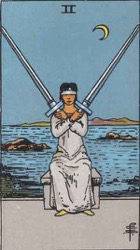
To fully understand the meaning of where and how Justice is applied, when this card appears, it is worth comparing its similarities to the 2 Of Swords. If you have ever seen a statue of Lady Justice then you will be familiar with the scales she holds in one hand and the sword in the other. The difference between Tarot's traditional depiction of Justice, including the RWS, is that Lady Justice wears a blind fold but Tarot's Justice does not. Pamela C. Smith illustrated the character in her 2 of Swords wearing a blind fold. The blind fold represents impartiality and the 2 of Swords card meaning is one of decision making without regard to wealth, power, status or emotion and based on logical reasoning alone. Tarot's Justice does not wear a blind fold because she takes all factors into consideration. Remember that the Major Arcana cards represent the combination of all the elements and not just one as in each Minor Arcana suit. Therefore Justice weighs on her scales all the elements in applying fairness and not just logical arguments. This does not mean that she is biased or prejudiced only that she will take into account material, emotional and constitutional factors as well as logical and factual arguments into consideration.
Take care not to confuse Judgement with Justice. These two are closely related but they are two separate stages in a process. Justice is the system and methods by which fairness is applied in trying to reach a decision. Judgement is the delivery and application of that decision. Justice is like a mathematical equation. When you enter values into an equation you get a result. Judgement is like that numerical answer you derive from putting values in an equation.
© Phuture Me Ltd 2010-2019. All rights reserved.
Justice in a Tarot Reading
Justice asks how fairness is being established. It concerns the principles, evidence and methods used to reach a decision, rather than simply announcing that someone will receive a reward or punishment. The way a matter is considered is part of its meaning.
Justice has a different role from both Judgement and the 2 of Swords. Judgement delivers the decision; Justice supplies the fair process behind it. Unlike the exclusively intellectual balance of the 2 of Swords, Justice considers emotional, material and other relevant circumstances alongside the facts.
Upright Meaning
Upright, Justice can indicate a need for proportionate, consistent treatment. An agreement, dispute or responsibility may need to be examined carefully so that neither preference nor convenience determines the outcome. Listening to all relevant sides is part of reaching a sound conclusion.
Fairness does not always mean giving everyone exactly the same thing. Different contributions, needs or obligations may matter. The card asks that these differences be weighed openly rather than used as hidden excuses for favouritism.
Its numerological connection with 2 reinforces balance and diplomacy. Where competing interests exist, Justice suggests a method through which they can be considered together. It may concern formal rules or agreements, but it applies just as readily to the ordinary decisions by which people treat one another fairly.
Upright keywords: fairness, balance, evidence, accountability, proportion, agreements, impartial consideration, fair process.
Reversed Meaning
Reversed, Justice can indicate an unfair process, selective evidence or inconsistent standards. Someone may insist on rules for others while expecting exceptions for themselves. A technically correct argument may also overlook circumstances essential to a genuinely fair result.
Alternatively, you may be struggling to identify what fairness requires because important information is missing or your own involvement makes the issue difficult to assess. The reversal need not establish deliberate dishonesty; it can expose a process that needs correction before a decision is made.
Look at how conclusions are reached, not merely whether you like them. An unwelcome outcome is not automatically unjust, just as a favourable one is not proof of fairness.
Reversed keywords: unfairness, bias, selective evidence, unequal treatment, double standards, imbalance, flawed agreements, avoided responsibility.
Love and Relationships
Justice in a relationship asks whether responsibilities, expectations and consideration are fairly shared. One partner may be carrying work that the other barely notices. A useful conversation makes those contributions visible without turning every act of affection into an accounting exercise.
It can also concern agreements about commitment, separation or the practical shape of life together. Reversed, resentment may grow from unequal standards or from feeling unheard. The card encourages examining both people's circumstances; it does not declare one partner guilty simply because the other feels wronged.
Work and Career
At work, Justice can point to transparent decisions about recruitment, pay, responsibilities or performance. Clear criteria help distinguish fair assessment from personal preference. If you are making the decision, consider whether you could explain the process consistently to everyone affected.
If you are being assessed, accurate records and a clear account of your contribution can be useful. Reversed, unclear expectations or rules applied unevenly may be the central problem. Identify the specific inconsistency before assuming that every difficulty is a personal attack.
Money and Finances
For money questions, Justice often concerns the fairness of an exchange or the terms of a shared obligation. What has each person agreed to provide, receive or repay? The issue may be less about the amount available than about whether the arrangement is understood and equitable.
Reversed, omitted details or unequal expectations can produce disputes. Read the actual terms and distinguish an emotional sense of obligation from an agreement you have made. The card supports careful consideration; it does not predict the result of a legal or financial claim.
Advice from Justice
Create a process you would recognise as fair even if you stood on the other side of it. Check the evidence, acknowledge relevant circumstances and apply the same principles consistently. A balanced decision needs both clear reasoning and an honest view of its effects.
Ask yourself: Would I consider this process fair if its decision went against me?
Justice is strongest when fairness belongs to the method as well as to the outcome you hope to receive.
© Phuture Me Ltd 2026. All rights reserved.
Justice According to A. E. Waite
The Pictorial Key to the Tarot
Arthur Edward Waite (1911)
As this card follows the traditional symbolism and carries above all its obvious meanings, there is little to say regarding it outside the few considerations collected in the first part, to which the reader is referred.
It will be seen, however, that the figure is seated between pillars, like the High Priestess, and on this account it seems desirable to indicate that the moral principle which deals unto every man according to his works--while, of course, it is in strict analogy with higher things;--differs in its essence from the spiritual justice which is involved in the idea of election. The latter belongs to a mysterious order of Providence, in virtue of which it is possible for certain men to conceive the idea of dedication to the highest things. The operation of this is like the breathing of the Spirit where it wills, and we have no canon of criticism or ground of explanation concerning it. It is analogous to the possession of the fairy gifts and the high gifts and the gracious gifts of the poet: we have them or have not, and their presence is as much a mystery as their absence. The law of Justice is not however involved by either alternative. In conclusion, the pillars of Justice open into one world and the pillars of the High Priestess into another.
Related Tarot Cards
 |
 |
 |
 |
 |
 |
© Phuture Me Ltd 2019. All rights reserved.
 Tarot & Numerology