
Introduction
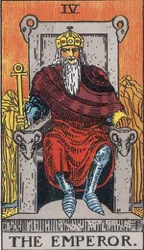
Court cards, like the King of Wands, are unnumbered which makes using numerology to unlock their basic symbology more challenging. On the surface we have the male ruler of the elemental domain of Fire but not much else to go on. We can however link Tarot's Kings to their supreme ruler and card number 4 of the Major Arcana, The Emperor, which would give any King a numerological attribute of 4 by proxy.
The same element and numerology is found in the 4 of Wands with its 4 wooden pillars making the foundations of a structure. That card's interpretations can range from building work to a marriage; anything that has a theme of creating a foundation of a home, community or work place.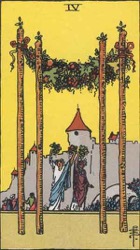 The King of Wands is the founder of whatever organisation that structure was erected for. In a marriage he is the groom, the good husband and perhaps even the father. In the community he is a leader. In the work place the boss.
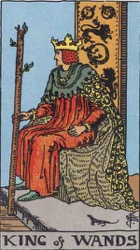
The Rider-Waite-Smith (RWS) Deck's King of Wands faces left, or west, symbolising the past. In traditional decks, like the Marseille, he had been depicted facing front, head turned slightly to the right. The RWS King would appear to be obsessed with past achievements and projects. This could be interpreted as conservatism. A need to preserve whatever foundations have been laid and maintain the structures upon them as they are. This is in contrast to the Queen of Wands who faces in the opposite direction, nurturing new growth and projects.
The King of Wands, also known as the King of Rods or King of Batons, is a mature* man whose vocation in life is related to the element of fire, home or construction (for example a fire fighter, an architect, an engineer, a carpenter or joiner). The symbolic relationship to this card may not be vocational. It could be a description of his personality. In this case, this man may be a family orientated man, a married man or a passionate, fiery, man. He could be a man who prefers to live in the countryside than a town or city. This is a man who has a love of nature.
*maturity happens between ages 28 to 37, when a man enter's his 2nd numerological life cycle.
© Phuture Me Ltd 2010-2019. All rights reserved.
King of Wands in a Tarot Reading
The King of Wands is the founder and maintainer of a structure in home, community or work. Where the 4 of Wands lays a dependable foundation, this King represents the person responsible for the organisation or life built upon it. Established commitment is central to the role.
The RWS figure's attention towards the past adds a conservative quality. Previous achievements and familiar ways of working may be important to preserve. The question is whether that loyalty keeps the foundation useful or prevents it responding to the needs of the present.
Upright Meaning
Upright, the King of Wands can indicate reliable leadership of an established undertaking. Someone may take responsibility for keeping a household, business or community organisation functioning. Their value lies in continuity and their willingness to stand behind what has been created.
The connection with The Emperor supplies the stability of 4 to Fire. Energy is maintained within a durable structure rather than repeatedly spent on fresh beginnings. The card can represent a parent, partner, founder or manager, while the quality of the role matters more than gender or age.
Respect for earlier work can preserve useful knowledge and prevent each new phase from starting unnecessarily from scratch. The King is strongest when that respect remains connected with the living purpose of the undertaking, allowing maintenance to support people rather than only protect tradition.
Upright keywords: established leadership, founding responsibility, dependable energy, preservation, family commitment, continuity, stewardship of projects, stable organisation.
Reversed Meaning
Reversed, the King of Wands may indicate authority becoming defensive about its own history. A founder may treat every suggested change as criticism of the original achievement. The structure then serves the preservation of status more than the needs for which it was established.
Another expression is a failure to maintain what has been built. Passion for the founding moment may not extend to ongoing responsibilities, or a leader may expect loyalty while neglecting the practical work that earns it.
Context helps distinguish useful continuity from rigidity or absent stewardship. Ask what still functions, what needs attention and whether the person in charge can separate the undertaking's future from their personal claim over its past.
Reversed keywords: rigid leadership, attachment to past success, neglected maintenance, controlling authority, defensive conservatism, unreliable responsibility, stalled development.
Love and Relationships
In relationships, the King of Wands can describe a dependable commitment to home and family. The person may take pride in the life that has been established and work to keep it secure. Their care often appears through responsibility and continued participation.
Reversed, attachment to a familiar family role may make changing needs difficult to hear. A partner may insist that the household continue as it always has because that structure once worked well. Discuss what the foundation is meant to support now, while acknowledging the effort that created it.
Work and Career
At work, this card can represent a founder, boss or experienced leader whose identity is closely linked to the organisation. Knowledge of its history can support consistent decisions and preserve the strengths on which later work depends.
Reversed, past achievement may become a reason to reject new evidence or methods. Alternatively, the leader may be absent from the less glamorous work of keeping the organisation sound. Evaluate the current contribution as well as the founding story. An established role remains useful through the responsibilities it continues to fulfil.
Money and Finances
For finances, the King of Wands may concern maintaining the resources that support a home, business or long-term project. The emphasis is continuity of the undertaking rather than accumulation for its own sake. Spending may be judged by whether it protects an established foundation.
Reversed, resources may preserve an outdated arrangement or be withheld from necessary improvements. Pride in what has already been built can make its present costs difficult to assess. Review whether the commitment still serves the people and purpose that depend on it.
Advice from the King of Wands
Accept responsibility for the life of what you have helped establish. Preserve the strengths that remain useful and recognise maintenance as active work. Let experience inform change without allowing attachment to your earlier achievement to rule out every new contribution.
Ask yourself: Am I maintaining a living foundation, or defending the memory of the moment I built it?
The King of Wands gives past effort lasting value when leadership continues to serve the undertaking's present life.
© Phuture Me Ltd 2026. All rights reserved.
King of Wands According to A. E. Waite
The Pictorial Key to the Tarot
Arthur Edward Waite (1911)
The physical and emotional nature to which this card is attributed is dark, ardent, lithe, animated, impassioned, noble. The King uplifts a flowering wand, and wears, like his three correspondences in the remaining suits, what is called a cap of maintenance beneath his crown. He connects with the symbol of the lion, which is emblazoned on the back of his throne. Divinatory Meanings: Dark man, friendly, countryman, generally married, honest and conscientious. The card always signifies honesty, and may mean news concerning an unexpected heritage to fall in before very long. Reversed: Good, but severe; austere, yet tolerant.
Related Tarot Cards
 |
 |
 |
 |
© Phuture Me Ltd 2018. All rights reserved.
 Tarot & Numerology