
Introduction
Kingdom: a country ruled by a king (or queen).
Empire: a group of countries (under one ruler).
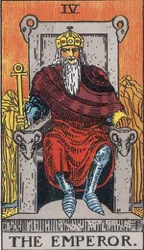
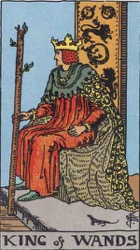
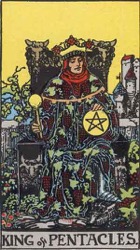
The Emperor is the King of Kings. Each King in the Minor Arcana reigns over one elemental domain. The King of Cups is the masculine ruler of Water. The King of Pentacles is the masculine ruler of Earth. The Emperor is ruler of all 4 Elemental Kingdoms.
In the Rider Waite Smith (RWS) Deck The Emperor has long white hair and a white beard in stark comparison to his younger Kings who have clean shaven, youthful faces. Unlike The Empress he puts on no show of his wealth and domains. No fertile lands behind him, only a hint of a river running at the foot of mountains that dominate the background view. The overwhelming theme here is one of rock.
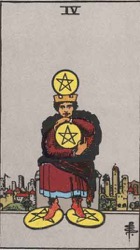
As the Empress represents being creative, or expressive, with all the elements combined The Emperor represents the solidification of the elements into a rigid, unchanging, structure. This is where the number 4 links to the number of Death, 13 (1+3=4). To survive we must continuously evolve, adapt and change. The Emperor won't and his aged looks symbolise a man who is nearing his end, who might be a bit stuck in his ways and unwilling to compromise. However he is dependable, reliable, trustworthy, an anchor in a storm.
"Men are born soft and supple; dead they are stiff and hard. Plants are born tender and pliant; dead, they are brittle and dry. Thus whoever is stiff and inflexible is a disciple of death. Whoever is soft and yielding is a disciple of life. The hard and stiff will be broken. The soft and supple will prevail.” - Lao-Tse
The Emperor represents masculinity, being in control, leadership and power. It can foretell the advancement of social, or career, status. The Emperor represents a reliable man upon whom others can depend. He is the husband to The Empress. If both of these cards appear in a Tarot spread it can indicate a married couple or a marriage. As the Empress is a mother so The Emperor is a father, or father figure.
Numerology: The Emperor is card number 4 of the Major Arcana. This is the number of stability and rigidity. This is key to The Emperor's strength but it is also a rigid and restrictive number which can also indicate a risk of stagnation or unwillingness to change. This card can sometimes represent an inflexible, rigid person, or situation, that needs to be worked around or through to reach a goal.
© Phuture Me Ltd 2010-2018. All rights reserved.
The Emperor in a Tarot Reading
The Emperor represents an established structure on which others can depend. As the ruler above the four Kings, he brings their separate elemental domains under one authority. His strength is the ability to hold things together, provide continuity and make responsibility visible.
The same solidity can become a limitation. The dependable anchor can also become the rigid figure who resists change. The number 4 helps explain this tension: stability protects what has been built, but a structure that cannot adapt may eventually obstruct life within it.
Upright Meaning
Upright, The Emperor can describe reliable leadership, clear responsibilities and an arrangement that has enough substance to withstand pressure. Someone may be taking charge because others need consistency, direction or a decision they can act upon.
It can represent a father, father figure, senior authority or the role of providing dependable support. These qualities can be expressed by anyone. The relevant question is what the person does: whether they create security, accept responsibility and remain trustworthy when circumstances are demanding.
An established position can bring influence or recognition, but it also brings obligations. The Emperor is not merely the privilege of giving orders. His value is demonstrated when the structure he maintains allows those relying on it to feel secure and understand where they stand.
Upright keywords: stability, dependable leadership, authority, responsibility, structure, protection, established position, reliable support.
Reversed Meaning
Reversed, The Emperor can indicate rigidity, overbearing authority or rules maintained after their purpose has been lost. Someone may resist a reasonable change because it threatens their accustomed position. Security then becomes a justification for restricting everyone else's movement.
The reversal can also describe a failure of structure: unreliable leadership, unclear boundaries or responsibilities that no one accepts. Surrounding cards help distinguish too much control from too little dependable support. The remedies are different even though both situations leave people unable to function freely and confidently.
Ask whether the framework still serves the people within it. Strengthening a weak arrangement may be necessary, while tightening an already inflexible one may deepen the problem.
Reversed keywords: rigidity, domination, inflexibility, unreliable authority, weak foundations, restrictive rules, neglected responsibility, stagnation.
Love and Relationships
In relationships, The Emperor can indicate commitment expressed through reliability and practical responsibility. Someone may show care by being present, providing support or maintaining the framework of shared life. It can also bring attention to fatherhood or an established family role.
Alongside The Empress, this card can represent a married couple or marriage when the context supports that reading. Reversed, a partner may confuse being dependable with having the final word on everything. Equally, a lack of follow-through may leave the other person carrying the structure alone. Look at how responsibility and influence are shared.
Work and Career
At work, The Emperor can represent management, promotion or the need to organise responsibilities clearly. A reliable system may be more useful than another burst of enthusiasm. People need to know who decides, who acts and what standards apply.
Reversed, established procedures can become obstacles when conditions change. Alternatively, leadership may be absent just when a decision is required. Consider whether the workplace needs clearer authority or a leader willing to revise an old approach. Seniority alone does not settle which response is appropriate.
Money and Finances
For money questions, The Emperor concerns a stable material framework: regular commitments, clear ownership and dependable arrangements. The emphasis is the capacity to support ongoing responsibilities rather than the excitement of a new opportunity.
Reversed, excessive control can prevent useful adjustments, while lack of structure can make ordinary obligations harder to manage. Examine whether your arrangements remain suitable for current circumstances. A system that once provided security may need updating without abandoning the discipline that made it effective.
Advice from The Emperor
Make your commitments dependable and your boundaries understandable. Then test whether the structure you are defending still protects what matters. Authority is more useful when it can distinguish an essential principle from a habit that has become unnecessarily rigid.
Ask yourself: What must remain firm here, and what needs to adapt for that stability to remain useful?
The Emperor provides an anchor, but even a strong anchor must serve the life of the vessel it holds.
© Phuture Me Ltd 2026. All rights reserved.
The Emperor According to A. E. Waite
The Pictorial Key to the Tarot
Arthur Edward Waite (1911)
He has a form of the Crux ansata for his sceptre and a globe in his left hand. He is a crowned monarch--commanding, stately, seated on a throne, the arms of which axe fronted by rams' heads. He is executive and realization, the power of this world, here clothed with the highest of its natural attributes. He is occasionally represented as seated on a cubic stone, which, however, confuses some of the issues. He is the virile power, to which the Empress responds, and in this sense is he who seeks to remove the Veil of Isis; yet she remains virgo intacta.
It should be understood that this card and that of the Empress do not precisely represent the condition of married life, though this state is implied. On the surface, as I have indicated, they stand for mundane royalty, uplifted on the seats of the mighty; but above this there is the suggestion of another presence. They signify also--and the male figure especially--the higher kingship, occupying the intellectual throne. Hereof is the lordship of thought rather than of the animal world. Both personalities, after their own manner, are "full of strange experience," but theirs is not consciously the wisdom which draws from a higher world. The Emperor has been described as (a) will in its embodied form, but this is only one of its applications, and (b) as an expression of virtualities contained in the Absolute Being--but this is fantasy.
Related Tarot Cards
 |
 |
 |
 |
© Phuture Me Ltd 2018. All rights reserved.
 Tarot & Numerology