
Introduction
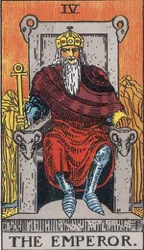
Court cards, like the King of Swords, are unnumbered which makes using numerology to unlock their basic symbology challenging. On the surface we have the male ruler of the elemental domain of Air but not much else to go on. We can however link Tarot's Kings to their supreme ruler and card number 4 of the Major Arcana, The Emperor, which would give any King a numerological attribute of 4 by proxy.
The same element and numerology is found in the 4 of Swords. The suit of Swords tends toward the negative aspects of numerology but the 4 of Swords is one of the exceptions with its peaceful knight lying on top of a coffin in what appears to be inside a church. Is he dead or alive and just meditating on his own mortality?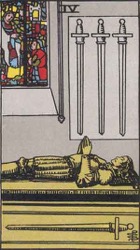 The King and this Knight are both linked to Tarot's Death card in numerology, since 13 reduces to 4 (1+3). Both cards have the duality of representing life or death. The King, with his raised sword, may be about to pass a sentence of capital punishment. There's a potential threat of an abrupt ending.
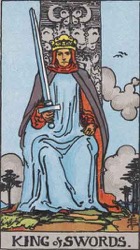
The Rider-Waite-Smith (RWS) Deck's King of Swords is unusual in that it is one of only three minor arcana cards whose character is looking directly at you. The other two being the 9 Of Cups and the 4 Of Pentacles. This King is not a man who is making future plans or dwelling on past issues and conflicts. His attention is in the present moment and, with his raised sword, he is dealing with what is happening right now.
Unlike the Queen Of Swords who is looking for, or guarded against, potential future problems the King is dealing with real current problems. When estimating timing of events in Tarot this King would be the best candidate for right now or immediately.
The King of Swords may be a mature* man whose vocation in life is related to the element of air (pilot, air steward, meteorologist, etc), intellectual challenges (teacher, academic, scientist, lawyer, judge etc), surgical professions (dentist, surgeon etc) or defence (soldier, policeman etc). The Swords offer a great range of vocational possibilities in their symbolism. The symbolic relationship to this card may not be vocational, it could be a description of his personality. In this case this man could be cold or domineering, argumentative, arrogant, authoritative, assertive, career minded or ambitious. His positive traits could be that he is brave and courageous or highly intelligent. He could even be someone who has spent time in prison or lives outside of the law.
*maturity happens between ages 28 to 37, when a man enter's his 2nd numerological life cycle.
© Phuture Me Ltd 2010-2019. All rights reserved.
King of Swords in a Tarot Reading
The King of Swords deals with the matter in front of him. Unlike the Queen's attention to potential future difficulties, his gaze is directed at the present. A real question, conflict or decision requires clear thought and the authority to respond now.
The connection with The Emperor and 4 gives this King firmness and intellectual stability. The raised sword also carries the possibility of a decisive conclusion. The card asks how that authority is exercised, and whether the decision is grounded in the actual circumstances.
Upright Meaning
Upright, the King of Swords can indicate a person able to confront a current problem directly. Clear reasoning, relevant knowledge or professional experience may be needed. The useful quality is the ability to distinguish the immediate issue from distractions about what happened before or what might happen later.
The card can represent an expert or decision-maker, but it can also describe the role you need to take. A situation may require you to state the facts, establish a boundary or make a conclusion that cannot remain indefinitely open.
Authority has consequences. A firm decision may close an option or end an arrangement, so accuracy and proportion matter. The King's present attention is a strength when it supports fair understanding; it becomes less useful if certainty is treated as permission to ignore information or other people's legitimate concerns.
Upright keywords: present judgement, intellectual authority, clear reasoning, firm decisions, professional knowledge, direct attention, boundaries, decisive conclusions.
Reversed Meaning
Reversed, the King of Swords may indicate authority used coldly or rigidly. A person can insist on their interpretation while refusing the evidence needed to test it. The ability to make a decision then becomes a means of domination rather than a service to the matter being decided.
Another expression is failure to exercise necessary judgement. An immediate issue may remain unresolved because the person responsible avoids a difficult conclusion or lacks the information required to make it responsibly.
Context helps distinguish excessive authority from absent authority. Ask what decision is needed, who has the responsibility to make it and whether their reasoning can be explained. A forceful tone does not compensate for weak grounds, while hesitation does not automatically indicate fairness.
Reversed keywords: domineering judgement, rigid reasoning, misused authority, avoided decisions, cold communication, unsupported certainty, weak accountability.
Love and Relationships
In relationships, the King of Swords can describe addressing a concrete issue directly. A clear conversation about expectations or boundaries may be necessary when ambiguity has become unhelpful. The card concerns the present problem rather than a general prediction about the relationship's future.
Reversed, one partner may treat their reasoning as the final authority and dismiss the other's experience. Alternatively, a necessary decision may keep being postponed. Make the matter specific enough to discuss, and allow clarity to include both the facts and the responsibilities people have towards one another.
Work and Career
At work, this card can indicate a senior professional, decision-maker or task requiring disciplined analysis. The issue may need a prompt and defensible conclusion. Relevant expertise is valuable when it is applied to the circumstances actually present.
Reversed, rank may be used to end discussion before the evidence has been considered, or responsibility may be passed around to avoid a difficult call. Establish the decision, criteria and accountable person. The goal is a sound response to the current problem, not simply the appearance of decisive leadership.
Money and Finances
For finances, the King of Swords can concern a formal decision, clear assessment or professional explanation of a current obligation. Precise understanding may help separate the actual requirements from assumptions or emotional reactions around them.
Reversed, an authoritative presentation may conceal unclear reasoning, or delay may leave a necessary matter unresolved. Ask for the basis and implications of the decision in terms you can understand. The card does not validate a person's advice simply because their role or manner appears commanding.
Advice from the King of Swords
Give the present issue your full attention. Establish the facts, use the knowledge relevant to the decision and make your reasoning clear. Be firm where a boundary or conclusion is needed, while remaining willing to correct the judgement if the evidence requires it.
Ask yourself: What decision is actually required now, and can I justify it from the facts before me?
The King of Swords gives authority its value through clear, accountable judgement applied to the matter at hand.
© Phuture Me Ltd 2026. All rights reserved.
King of Swords According to A. E. Waite
The Pictorial Key to the Tarot
Arthur Edward Waite (1911)
He sits in judgment, holding the unsheathed sign of his suit. He recalls, of course, the conventional Symbol of justice in the Trumps Major, and he may represent this virtue, but he is rather the power of life and death, in virtue of his office. Divinatory Meanings: Whatsoever arises out of the idea of judgment and all its connexions-power, command, authority, militant intelligence, law, offices of the crown, and so forth. Reversed: Cruelty, perversity, barbarity, perfidy, evil intention.
Related Tarot Cards
 |
 |
 |
 |
© Phuture Me Ltd 2018. All rights reserved.
 Tarot & Numerology