
Introduction
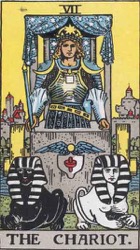
Tarot's Knights, like the Knight of Wands, are related to The Chariot They can be thought of as the Captains of their element, in this case Fire, led by their leader The Charioteer who is warlord of all the elements. As The Chariot is card number 7 of the Major Arcana we can assign any Knight a numerological attribute of 7 by proxy. The numerological traits of the number 7 are rest, inaction, planning, analysing and waiting. A Knight, just like The Chariot, cannot represent attack and should only be defensive. They wear simple, practical, armour without ceremonial, or rank defining, decoration. Helmets, not crowns. Their display is purely one of defending their element.
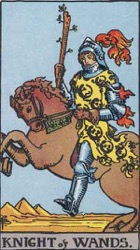
The Chariot and Knights, with the exception of the Knight of Swords, represent defence. The Rider-Waite-Smith (RWS) Tarot deck emphasised their defensive nature by cladding them in armour. In the older Tarot decks, like the Marseilles, only the Knight of Swords is wearing armour and holding a weapon. The key theme with the Knight of Wands is one of defending ones work or home. The imagery of the card you are looking at should illustrate the mind set. In both the Marseilles and RWS decks the horse backed knight is heading left/east which represents the past. His right hand holds a single wand upright, not forward in an attacking gesture the Knight of Swords. Just as the Ace of Wands signifies a new project, job or home, this card does too but with the caveat that it's being done with caution or resistance.
The Marseilles decks usually depict both the horse and rider heading left/east (the past) but both man and steed are looking backwards west/right (the future). This may indicate a reluctance to engage with something that can be seen approaching from the future. The Rider-Waite-Smith (RWS) Deck changed this feature so both man and horse are facing in the direction they are travelling. In addition to this change the horse is rearing up with it's master pulling so tightly on it's reins that it's head is pulled as far back as it will go. The detail is worth noting as it indicates a need to control power and direction. The Knight wants to remain stationary, or is reluctant to head in that direction, but what is under him is bursting with energy and raring to go. Heading backwards, towards the past, may be taken as the wrong direction. The element of fire can represent the physical energy that one would apply to work and projects but it is also about passion, energy and drive which, if uncontrolled, can be damaging and dangerous. The Marseilles Knight maybe symbolising a reluctance to take on a job or apply ones efforts to something. The RWS Knight may also symbolise keeping control of a project and not allowing other forces to take it in the wrong direction.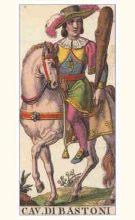
Returning to the theme of defence that runs within the Knight and the Chariot this Knight could signify a need to take defensive measure at home or in the work place. For example home improvements or repairs that maybe needed to prevent damage from the elements. Another example would be guarding, or being defensive about, ones position, or project at work.
The Knight of Wands, also known as the Knight of Rods or Knight of Batons, could be a young* man who has not reached maturity** yet. His vocation in life could be related to the element of fire, home or construction (for example a fire fighter, an architect, an engineer, a carpenter or joiner). The symbolic relationship to this card may not be vocational, it could be a description of his personality. In which case this youth may be passionate, fiery or changeable. He could be someone who prefers to live in the countryside than a town or city. Someone who has a love of nature.
*the age of this man could be relative to the person the reading is for. He maybe a mature man but a younger man.
**maturity happens between ages 28 to 37, when a man enter's his 2nd numerological life cycle.
© Phuture Me Ltd 2010-2019. All rights reserved.
Knight of Wands in a Tarot Reading
The Knight of Wands controls energy that is eager to move. The rearing horse is not simply an invitation to charge ahead: the rider is pulling on the reins. His task is to keep a project, ambition or impulse from being carried in an unhelpful direction.
The link with The Chariot and 7 makes this a defensive card. It can concern protecting the home or workplace, resisting a poorly timed undertaking or maintaining direction when enthusiasm becomes difficult to contain. Available energy still needs judgement about its use.
Upright Meaning
Upright, the Knight of Wands can indicate a need to restrain or guide a powerful impulse. A project may have enough enthusiasm to move quickly but not enough clarity to move well. Keeping control can prevent a costly detour or damage caused by premature action.
The card can also describe resistance to taking on a task whose direction feels wrong. That resistance deserves examination rather than an automatic label of laziness. Ask whether the person is protecting a reasonable limit or reacting to an earlier experience that no longer applies.
As a practical defender, the Knight may concern repairs, safeguards or protection of established work. As a person, the figure can be passionate and capable while still learning how to handle that force. The relevant quality is the management of Fire, not a fixed age or gender.
Upright keywords: controlled energy, restrained impulse, protected projects, cautious engagement, defensive action, directed passion, resistance, practical safeguards.
Reversed Meaning
Reversed, the Knight of Wands may indicate the reins being lost. Enthusiasm, frustration or outside pressure can send an undertaking forward before its direction is sound. The problem is not necessarily a shortage of energy, but its release without sufficient control.
Another expression is excessive restraint. A project may be held still because any movement feels risky, even after the concern has been addressed. Caution can then consume the energy it was meant to direct.
Context helps distinguish reckless momentum from unnecessary resistance. Review the actual route and the reason for stopping. A useful decision should make the next action more deliberate, whether that means slowing down, changing direction or allowing a prepared effort to proceed.
Reversed keywords: uncontrolled drive, rash action, frustrated momentum, excessive restraint, impulsive projects, misdirected energy, stubborn resistance.
Love and Relationships
In relationships, the Knight of Wands can concern the pace of shared activity or the handling of strong passion. A household plan may need restraint before enthusiasm commits both people to more than they can manage. The card does not automatically describe an impulsive romantic adventurer.
Reversed, intensity may determine decisions before expectations are discussed. Alternatively, one partner may block every new undertaking in the name of caution. Identify the specific concern and the conditions under which movement would become reasonable, so that restraint has a purpose both people can understand.
Work and Career
At work, this card can indicate keeping a project on course, resisting uncontrolled expansion or preventing an energetic team from moving in the wrong direction. The person holding the reins may be protecting the outcome rather than obstructing progress.
Reversed, pressure for visible action may override preparation, or a manager may restrain work after the relevant risks have been addressed. Examine the decision point carefully. Effective control permits purposeful movement and interrupts movement that would waste effort, rather than treating speed itself as either success or failure.
Money and Finances
For finances, the Knight of Wands may concern controlling the spending attached to an ambition, home project or burst of enthusiasm. The undertaking can be worthwhile while still needing limits. Energy often creates new commitments faster than their total cost becomes apparent.
Reversed, resources may be committed impulsively, or fear may prevent a necessary protective expense. Clarify what the proposed action actually supports. A practical safeguard and an exciting addition can look similar when both are presented as urgent, but they serve different purposes.
Advice from the Knight of Wands
Hold the reins firmly enough to choose the direction. Identify the force trying to move the situation and decide whether its destination serves the undertaking. Restraint should protect the useful energy rather than extinguish it or become a permanent refusal to act.
Ask yourself: Am I directing this energy towards the right purpose, or letting its intensity choose the route?
The Knight of Wands makes passion more effective by keeping power and direction under conscious control.
© Phuture Me Ltd 2026. All rights reserved.
Knight of Wands According to A. E. Waite
The Pictorial Key to the Tarot
Arthur Edward Waite (1911)
He is shewn as if upon a journey, armed with a short wand, and although mailed is not on a warlike errand. He is passing mounds or pyramids. The motion of the horse is a key to the character of its rider, and suggests the precipitate mood, or things connected therewith. Divinatory Meanings: Departure, absence, flight, emigration. A dark young man, friendly. Change of residence. Reversed: Rupture, division, interruption, discord.
Related Tarot Cards
 |
 |
 |
 |
© Phuture Me Ltd 2018. All rights reserved.
 Tarot & Numerology