
Introduction
The Chariot, like The Fool, is a card that has been named in a way that often leads to confusion about its meaning and what it truly represents.
The clue is in this card's numerology. The number 7 is not about advancing, attacking, movement, progress or any action. The number 7, when playing to its positive attributes, is about rest, reflection, planning and waiting.
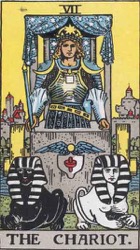
Many modern Tarot deck artists take the name and incorrectly depict The Chariot in full flight, charging somewhere. If you look at the traditional tarot decks like the Marseilles or the Rider-Waite-Smith you'll see a chariot that is either completely at rest (RWS) or carrying a crowned, breast plated, prince posing in a relaxed manner (Marseilles).
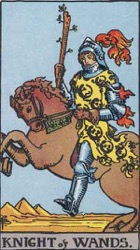
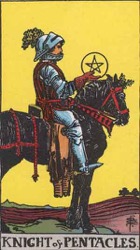
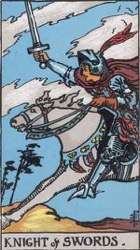
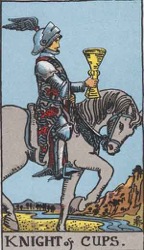
There's a beautiful structure to Tarot with its 4 minor suits, each representing a classical element, and the Major Arcana which combines the elements into a spiritual esoteric philosophy. We can see this structure in the direct relationships between court cards in the minor arcana and Major Arcana characters. e.g. The Queen's and The Empress, The Kings and The Emperor, The Pages and The Fool. The Knights also have a Major Arcana superior in The Chariot. Knights are typically dressed in medieval armour and are mounted on a horse. The Charioteer is usually also dressed in medieval armour but wears a crown, or head adornment, of royalty (see Marseilles Tarot decks or the RWS). He is the Prince, or King, of Knights. He could be a General, or leader, of an army who directs from behind but does not take an active part in fighting.
In both the Marseilles and RWS decks The Chariot is facing you head on. The Charioteer's gaze is directly at you matching that of the other Major Arcana Royalty, The Empress and The Emperor. Their minds and focus are in the present moment. You have their attention. If you look at the Knights in the RWS and Marseilles all four of them are facing either left (the past) or right (the future).
Combining all these symbolical observations we arrive at a person, or situation, that is all suited up and ready but isn't going anywhere. This should raise questions. Are they just putting on a show of strength and position? Are they waiting for you to make the first move? Are they, or are you, studying your opponent before taking action? Is this a traveller who has arrived at their destination and not one who is about to set out as we might have first assumed?
To understand The Chariot better compare it to the Knights who are focused on their element and facing either towards the past or the future. With the exception of the Knight of Swords, who displays the negative qualities of 7, the other 3 Knights are all being defensive. The Chariot, just like the Knights, is a defensive card. Another example of a defensive 7 in the Tarot deck is the 7 of Wands. The Major Arcana combines all four elements and spirit, or the divine, therefore this card could represent divine protection. Being in a state where nothing troubles you and you can rest and meditate in peace. In the RWS deck the masonic symbol of the mallet is on The Chariot's coat of arms. This represents not only self control but being master of ceremonies or presiding officer.
There's an element of showmanship about The Chariot. A display of potential, position, strength, wealth. You are being shown something because it wants to make a certain impression, which may or may not be its true self. Like a peacock with its feathers fanned out before you, you can't help but notice and admire it. That is the intention of the display. Its true nature and intent maybe hidden from you.
As always with Tarot a card can take on many meanings. The surrounding cards, your question and intuition will help you unveil The Chariot's message in your spread. Are you, or your intentions, The Chariot or is it someone else?
© Phuture Me Ltd 2010-2019. All rights reserved.
The Chariot in a Tarot Reading
The Chariot is ready, equipped and watchful. Its central meaning is not a charge towards victory, but the position of someone who can act and is choosing when, whether or how to do so. Preparation and visible strength are already present.
The number 7 supplies the themes of reflection, waiting and planning. As the superior of the four Knights, The Chariot brings their defensive qualities together. It can also represent an impressive display whose purpose deserves examination: what is this person or situation trying to make you believe?
Upright Meaning
Upright, The Chariot can suggest holding a secure position while studying the circumstances. You may be ready for the next step without yet needing to take it. Waiting can be an informed strategy when it gives you a clearer view of the situation or of another person's intentions.
It may describe a leader directing events without entering every contest personally. Resources, authority and preparation create the ability to respond, while self-control keeps that ability from being wasted on unnecessary action.
The display itself can be significant. Someone may be presenting status, wealth or confidence to encourage a particular response. That appearance may be justified, exaggerated or simply incomplete. In a travel question, consider whether the card describes someone who has already arrived rather than automatically assuming a journey is about to begin.
Upright keywords: readiness, strategic waiting, defence, self-control, presence, preparation, watchfulness, displayed strength, arrival.
Reversed Meaning
Reversed, The Chariot can indicate preparation that never becomes a useful response. A defensive position may harden into avoidance, or maintaining appearances may consume more effort than addressing the actual situation. Ask whether waiting still serves a purpose.
Another expression is the loss of restraint: acting to prove strength before understanding what is required. This differs from a considered decision to move. Surrounding cards help distinguish an overdue response from an impulsive attempt to break an uncomfortable pause.
The reversal can also expose a gap between impressive presentation and real capability. Look beneath the equipment, title or confident manner to see what support is actually available.
Reversed keywords: empty display, defensive avoidance, stalled readiness, premature action, insecure authority, lost restraint, appearances over substance.
Love and Relationships
In relationships, The Chariot can describe someone who is attentive and interested but keeping their position guarded. An impressive appearance or confident manner may be intended to attract attention while revealing little about actual intentions. Observe how the person responds when a genuine conversation is possible.
For a couple, it may concern protecting the relationship from outside pressure or pausing before a difficult discussion. Reversed, both partners may wait for the other to make the first move. Alternatively, one may act dramatically to break the stand-off. A direct explanation of intentions can be more useful than another display.
Work and Career
At work, The Chariot can represent strategic leadership, preparation for a meeting or the presentation of professional capability. The task may be to demonstrate that you are ready while allowing the right opportunity to develop.
It can also describe a role in which you coordinate others rather than perform every operation yourself. Reversed, polishing credentials or defending status may replace meaningful preparation. Check whether your presentation is supported by the resources and understanding needed when action is eventually required.
Money and Finances
For money questions, this card can favour understanding your position before committing resources. Having funds available does not require immediate expenditure; the ability to wait may itself be useful. It may also draw attention to purchases made primarily to display success.
Reversed, preserving an image of prosperity can weaken the security that image is meant to suggest. Alternatively, hesitation may continue after the relevant information is available. Clarify what you are waiting to learn and which circumstances would justify a decision.
Advice from The Chariot
Know why you are holding your position. Use the pause to observe, prepare and understand the impression being created on both sides. Readiness has value when it supports a conscious response, rather than becoming a performance with no purpose beyond itself.
Ask yourself: Am I waiting for a sound reason, or maintaining an appearance that hides my uncertainty?
The Chariot's command lies in being ready without being compelled to move merely to demonstrate that readiness.
© Phuture Me Ltd 2026. All rights reserved.
The Chariot According to A. E. Waite
The Pictorial Key to the Tarot
Arthur Edward Waite (1911)
An erect and princely figure carrying a drawn sword and corresponding, broadly speaking, to the traditional description which I have given in the first part. On the shoulders of the victorious hero are supposed to be the Urim and Thummim. He has led captivity captive; he is conquest on all planes--in the mind, in science, in progress, in certain trials of initiation. He has thus replied to the sphinx, and it is on this account that I have accepted the variation of Éliphas Lévi; two sphinxes thus draw his chariot. He is above all things triumph in the mind.
It is to be understood for this reason (a) that the question of the sphinx is concerned with a Mystery of Nature and not of the world of Grace, to which the charioteer could offer no answer; (b) that the planes of his conquest are manifest or external and not within himself; (c) that the liberation which he effects may leave himself in the bondage of the logical understanding; (d) that the tests of initiation through which he has passed in triumph are to be understood physically or rationally; and (e) that if he came to the pillars of that Temple between which the High Priestess is seated, he could not open the scroll called Tora, nor if she questioned him could he answer. He is not hereditary royalty and he is not priesthood.
Related Tarot Cards
 |
 |
 |
 |
© Phuture Me Ltd 2018. All rights reserved.
 Tarot & Numerology