
Introduction
“Violence is the last refuge of the incompetent.” - Isaac Asimov, Foundation
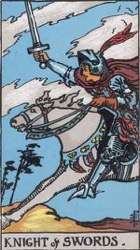
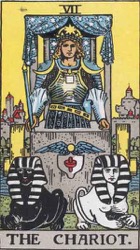
Tarot's Knights, like the Knight of Swords, are related to The Chariot. They can be thought of as the Captains of their element, in this case Air, led by their leader The Charioteer who is warlord of all the elements. As The Chariot is card number 7 of the Major Arcana we can assign any Knight a numerological attribute of 7 by proxy. The positive numerological traits of the number 7 are rest, inaction, planning, analysing and waiting. A Knight, just like The Chariot, should represent defence when it is expressing these positive traits. Knights wear simple, practical, armour without ceremonial, or rank defining, decoration. Helmets, not crowns. Their display is one of defending their element.
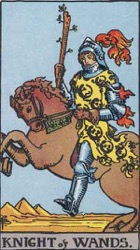
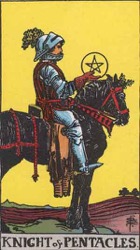
The attacking Knight of Swords is, as is often the case with the Suit of Swords, opposite to the defending Chariot and other Knights. Comparing the Knights further one should note that only the Knight of Swords is armed with a weapon. In the Marseilles decks the other three Knights do not wear armour nor are they armed with a weapon. Armour was added to these knights in the Rider-Waite-Smith (RWS) deck, probably to highlight their defensive nature, but they remain weaponless.
A commonly suggested theme for the Knight of Swords is one of rapid movement due to the RWS version depicting the knight driving his horse at full speed in what appears to be a battle charge. Speed of movement alone does not fully acknowledge what this card is telling us since it is not the only card in this deck that symbolises rapid movement. The 8 Of Wands, with it's flying sticks, makes a strong claim to this attribute.
The direction of travel is, as always, an important detail with both horse and rider heading left/east (into the past) or backwards. The direction would tend to indicate that this is a negative, wrong course of, action. Compare the action and direction of this card to the 5 Of Swords or the 7 Of Swords.
Combining all of these observations together it's difficult to see this as a positive card. Violence, or aggression, is never the answer. Keeping in mind that this is the element of Air, it doesn't necessarily mean physical aggression. It could be a verbal attack or a damaging letter, email or other communication.
"Before you speak, ask yourself: is it kind, is it necessary, is it true, does it improve on the silence?" - Sai Baba
The Knight of Swords could be a young* man who has not reached maturity** yet. His vocation in life could be related to the element of air (pilot, air steward, meteorologist, etc), intellectual challenges (teacher, academic, scientist, lawyer, etc), surgical professions (dentist, doctor, nurse etc) or defence (soldier, policeman etc). The Swords offer a great range of possibilities of vocation in their symbolism. The symbolic relationship to this card may not be vocational, it could be a description of his personality. In which case this youth could be aggressive, argumentative, arrogant, authoritative, assertive, career minded or ambitious. His positive traits can be that he is brave and courageous or highly intelligent. He could even be someone who has spent time in prison or lives outside of the law.
*the age of this man could be relative to the person the reading is for. He maybe a mature man but a younger man.
**maturity happens between ages 28 to 37, when a man enter's his 2nd numerological life cycle.
© Phuture Me Ltd 2010-2019. All rights reserved.
Knight of Swords in a Tarot Reading
The Knight of Swords drives thought into attack. The charging figure differs from the defensive Knights and The Chariot. The problem is not merely speed: it is the aggressive use of words, arguments or intellectual force to press a position forward.
That distinction separates this card from the momentum of the 8 of Wands. A rapid message can be efficient; a verbal charge can damage the very outcome it seeks. The card asks what the force of the response is doing to the situation.
Upright Meaning
Upright, the Knight of Swords can indicate an argument, sharp communication or a person intent on overpowering resistance. Intelligence and courage may be present, but they are being used in a way that leaves too little room for reflection or another perspective.
The Knight's relationship with 7 makes the missing pause especially relevant. The constructive qualities would be analysis and preparation, yet the charge bypasses them. A response may be sent while anger or certainty makes every delay feel intolerable.
The card can describe a letter, email or spoken attack without referring to physical violence. It is not evidence that someone will harm you. Identify the actual conduct and consider whether the immediate urge to strike back would repeat the same pattern in another direction.
Upright keywords: verbal aggression, forceful argument, rash communication, intellectual attack, combative certainty, impatience, aggressive ambition, unrestrained response.
Reversed Meaning
Reversed, the Knight of Swords may indicate aggression losing its direct route and emerging through repeated criticism, frustration or poorly controlled messages. An interrupted charge is not necessarily a considered response. The same intention can remain active beneath a less obvious form.
Alternatively, the person may begin recognising the damage caused by haste and choose to pause. A message can be revised, a confrontation reconsidered or a stronger argument formed without the need to attack.
Context helps distinguish de-escalation from redirected hostility. Look at whether the purpose and method have changed, not simply whether the volume has reduced. A useful response should advance understanding or protect a necessary boundary rather than merely deliver a sharper blow.
Reversed keywords: checked aggression, frustrated attack, revised communication, indirect hostility, reconsidered confrontation, scattered argument, developing restraint.
Love and Relationships
In relationships, the Knight of Swords can describe a conversation in which someone argues as though the partner were an opponent to defeat. Quick replies and cutting observations may feel powerful while making honest engagement less possible. The effect on trust belongs in the assessment.
Reversed, the pattern may begin to change, or hostility may continue through criticism and repeated messages. A pause can help prevent escalation, but it should lead to a different method of addressing the issue. Being direct does not require making the other person feel attacked.
Work and Career
At work, this card can indicate combative communication, an aggressive challenge or a person pursuing an objective without enough regard for colleagues. The argument may contain valid information while its delivery damages cooperation. Correctness does not remove that practical cost.
Reversed, a team may restrain an unhelpful confrontation or find that frustration is appearing indirectly. Keep the response tied to evidence, responsibility and the work that needs doing. A carefully framed objection can be firm without turning the discussion into a contest of force.
Money and Finances
For finances, the Knight of Swords can concern an angry demand, contentious negotiation or impulsive response to a material disagreement. The urge to answer immediately may make it harder to understand the terms or consequences. The card's subject is the mental approach around the matter.
Reversed, a pause may allow a more accurate response, or frustration may produce a stream of unhelpful exchanges. Review what is actually being requested and what you want the discussion to achieve. The strongest response is not necessarily the harshest one.
Advice from the Knight of Swords
Interrupt the charge long enough to examine its purpose. Keep the necessary facts and remove the parts intended only to wound, embarrass or overpower. If you are receiving the attack, respond to the actual issue and the relevant boundary rather than accepting the invitation to match its aggression.
Ask yourself: Will this response improve the situation, or only demonstrate how forcefully I can make my point?
The Knight of Swords warns that speed and intelligence can move a conflict further from its useful resolution.
© Phuture Me Ltd 2026. All rights reserved.
Knight of Swords According to A. E. Waite
The Pictorial Key to the Tarot
Arthur Edward Waite (1911)
He is riding in full course, as if scattering his enemies. In the design he is really a prototypical hero of romantic chivalry. He might almost be Galahad, whose sword is swift and sure because he is clean of heart. Divinatory Meanings: Skill, bravery, capacity, defence, address, enmity, wrath, war, destruction, opposition, resistance, ruin. There is therefore a sense in which the card signifies death, but it carries this meaning only in its proximity to other cards of fatality. Reversed: Imprudence, incapacity, extravagance.
Related Tarot Cards
 |
 |
 |
 |
© Phuture Me Ltd 2018. All rights reserved.
 Tarot & Numerology