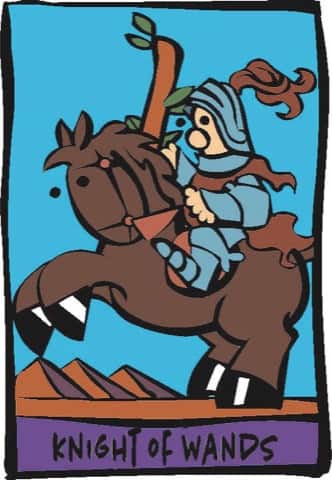
Deck: The Ator Tarot
by Robin Ator.
 Created on Phuture Me
Present Situation
Cause / Obstacles
Best outcome
Background
Recent Past
Future influences
Possible answer
Your resources
Feelings / Hopes / Fears
Outcome

Also available in our Tarot & Numerology App for Apple iOS & Android

Download on the App Store Get it on Google Play


Screenshot


Close

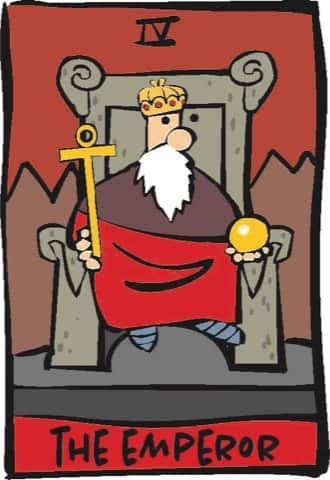
The Emperor Tarot card meaning and interpretation

Kingdom: a country ruled by a king (or queen).
Empire: a group of countries (under one ruler).

The Emperor is the King of Kings. Each King in the Minor Arcana reigns over one elemental domain. The King of Cups is the masculine ruler of Water. The King of Pentacles is the masculine ruler of Earth. The Emperor is ruler of all 4 Elemental Kingdoms.

In the Rider Waite Smith (RWS) Deck The Emperor has long white hair and a white beard in stark comparison to his younger Kings who have clean shaven, youthful faces. Unlike The Empress he puts on no show of his wealth and domains. No fertile lands behind him, only a hint of a river running at the foot of mountains that dominate the background view. The overwhelming theme here is one of rock.

four of Pentacles

The throne he sits upon is square cut, thick, hard stone. There is another King in the RWS deck who sits on a similar throne, The 4 of Pentacles. These cards have the same numerical value and numerological meaning of the number 4; rock solid stability.

As the Empress represents being creative, or expressive, with all the elements combined The Emperor represents the solidification of the elements into a rigid, unchanging, structure. This is where the number 4 links to the number of Death, 13 (1+3=4). To survive we must continuously evolve, adapt and change. The Emperor won't and his aged looks symbolise a man who is nearing his end, who might be a bit stuck in his ways and un-willing to compromise. However he is dependable, reliable, trustworthy, an anchor in a storm.
"Men are born soft and supple; dead they are stiff and hard. Plants are born tender and pliant; dead, they are brittle and dry. Thus whoever is stiff and inflexible is a disciple of death. Whoever is soft and yielding is a disciple of life. The hard and stiff will be broken. The soft and supple will prevail.” - Lao-Tse

The Emperor represents masculinity, being in control, leadership and power. It can foretell the advancement of social, or career, status. The Emperor represents a reliable man upon whom others can depend. He is the husband to The Empress. If both of these cards appear in a Tarot spread it can indicate a married couple or a marriage. As the Empress is a mother so The Emperor is a father, or father figure.

Numerology: The Emperor is card number 4 of the Major Arcana. This is the number of stability and rigitity. This is key to The Emperor's strength but it is also a rigid and restrictive number which can also indicate a risk of stagnation or unwillingness to change. This card can sometimes represent an inflexible, ridged person, or situation, that needs to be worked around or through to reach a goal.

© Phuture Me Ltd 2010-2018. All rights reserved.

THE PICTORIAL KEY TO THE TAROT

By Arthur Edward Waite (1911)

He has a form of the Crux ansata for his sceptre and a globe in his left hand. He is a crowned monarch--commanding, stately, seated on a throne, the arms of which axe fronted by rams' heads. He is executive and realization, the power of this world, here clothed with the highest of its natural attributes. He is occasionally represented as seated on a cubic stone, which, however, confuses some of the issues. He is the virile power, to which the Empress responds, and in this sense is he who seeks to remove the Veil of Isis; yet she remains virgo intacta.

It should be understood that this card and that of the Empress do not precisely represent the condition of married life, though this state is implied. On the surface, as I have indicated, they stand for mundane royalty, uplifted on the seats of the mighty; but above this there is the suggestion of another presence. They signify also--and the male figure especially--the higher kingship, occupying the intellectual throne. Hereof is the lordship of thought rather than of the animal world. Both personalities, after their own manner, are "full of strange experience," but theirs is not consciously the wisdom which draws from a higher world. The Emperor has been described as (a) will in its embodied form, but this is only one of its applications, and (b) as an expression of virtualities contained in the Absolute Being--but this is fantasy.

Related Tarot Cards

King of Wands Tarot card meaning and interpretation King of Pentacles Tarot card meaning and interpretation King of Swords Tarot card meaning and interpretation King of Cups Tarot card meaning and interpretation

© Phuture Me Ltd 2018. All rights reserved.

Close

Temperance Tarot card meaning and interpretation

Temperance is the 14th card of the Major Arcana which gives it a numerological value of 5 (1+4). This links it to the 5th card of the Major Arcana The Hierophant as well as the 5 Of Wands, the 5 Of Pentacles, the 5 Of Swords, and the 5 Of Cups of the minor arcana, all problematic cards, representing strife, hardship, conflict and grief respectively. Where The Hierophant offers an authoritarian solution to these problematic minors, using structures of rules, doctrine and dogma for control and containment, Temperance takes a more holistic approach by finding the right solution, mixture and balance for each individual case. The Hierophant represents external help, discipline and control, Temperance represents self help and self control.

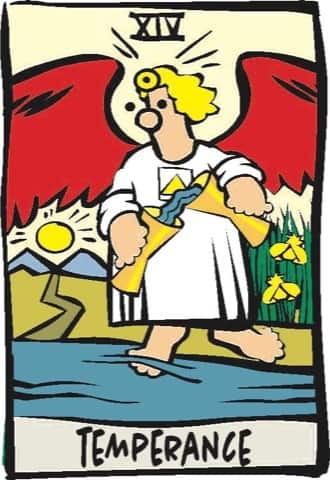
Temperance is the card of moderation, patience, self control, frugality and economy. The appearance of this card could offer a path to peace and harmony. Depending on cards surrounding Temperance, difficult situations or testing times can be managed through better self control. The imagery is commonly that of an angel pouring water from one vessel to another. The water flowing between the 2 cups represents getting the mixture right through the balance and diplomacy off the 2. With water being the ingredient being mixed and balanced, this is specifically about finding emotional balance and harmony. The angel in the Rider Waite Smith deck card has one foot on land (earth) and the other in a lake or sea (water). This detail indicates that this card doesn't refer entirely to emotional temperance but also to material temperance. Or the intersection of these elements where emotional decisions, or reactions, to material issues come into play.

Numerology: Temperance is the 14th card in the Major Arcana. Numerology reduces 14 to 5 (1+4). The number 5 has the positive characteristics of freedom, versatility, flexibility, adaptability. The negative and destructive influences of this number are instability, chaos, irresponsibility, carelessness and over indulgence in food, drink, drugs and sensuality (sex). Even though Temperance has the same basic numerology as The Hierophant the number 14 also symbolises self control (number 1) creating stability (number 4).

© Phuture Me Ltd 2010-2018. All rights reserved.

THE PICTORIAL KEY TO THE TAROT

By Arthur Edward Waite (1911)

A winged angel, with the sign of the sun upon his forehead and on his breast the square and triangle of the septenary. I speak of him in the masculine sense, but the figure is neither male nor female. It is held to be pouring the essences of life from chalice to chalice. It has one foot upon the earth and one upon waters, thus illustrating the nature of the essences. A direct path goes up to certain heights on the verge of the horizon, and above there is a great light, through which a crown is seen vaguely. Hereof is some part of the Secret of Eternal Life, as it is possible to man in his incarnation. All the conventional emblems are renounced herein.

So also are the conventional meanings, which refer to changes in the seasons, perpetual movement of life and even the combination of ideas. It is, moreover, untrue to say that the figure symbolizes the genius of the sun, though it is the analogy of solar light, realized in the third part of our human triplicity. It is called Temperance fantastically, because, when the rule of it obtains in our consciousness, it tempers, combines and harmonises the psychic and material natures. Under that rule we know in our rational part something of whence we came and whither we are going.

Related Tarot Cards

The Hierophant Tarot card meaning and interpretation Five of Wands Tarot card meaning and interpretation Five of Pentacles Tarot card meaning and interpretation Five of Swords Tarot card meaning and interpretation Five of Cups Tarot card meaning and interpretation

© Phuture Me Ltd 2018. All rights reserved.

Close

Five of Cups Tarot card meaning and interpretation

"It's no use crying over spilled milk"

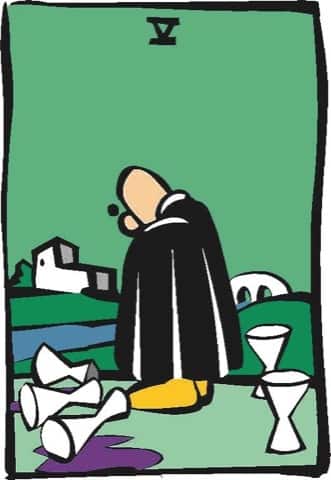
The Tarot imagery for this card is, in general, one of a sad figure lamenting over turned, empty, cups. The spilled water symbolising emotional loss. In the Rider Waite Smith (RWS) deck the person stands with their head bowed, facing left or west, looking at 3 over turned cups. A character who is facing left is focused on past events and, as the spilled cups are on the left, this is a past emotional loss and not something about to happen or in the future. In the RWS card we can't see their face and they wear a black cloak as someone who is in mourning. They have shut themselves off from others. On the right, in the future, are 2 upright cups. If our sad character was to put the past behind them, turn around and move on they'd see that the future offers something new emotionally.

In Numerology the negative aspects of the number 3 are unhappiness, sorrow, heart ache and loss. (See the 3 of Swords). The positive, emotional, attributes of the number 2 can be found in the 2 of Cups. In such a negative card as the 5 of cups these two full cups give hope, pointing to a brighter future. They represent something new to look forward to. The message here is to let the past go, accept what is and move on and embrace new, emotional, possibilities and partnerships.

The 5 of Cups is a card of emotional loss, regret, melancholy, self pity or feeling blue. The element here is Water which relates to love and emotions. In numerology the number 5's positive traits are change, detachment, adaptability and freedom. The negative traits are instability, irresponsibility, carelessness, thoughtlessness and over indulgence.

© Phuture Me Ltd 2010-2018. All rights reserved.

THE PICTORIAL KEY TO THE TAROT

By Arthur Edward Waite (1911)

A dark, cloaked figure, looking sideways at three prone cups two others stand upright behind him; a bridge is in the background, leading to a small keep or holding. Divanatory Meanings: It is a card of loss, but something remains over; three have been taken, but two are left; it is a card of inheritance, patrimony, transmission, but not corresponding to expectations; with some interpreters it is a card of marriage, but not without bitterness or frustration. Reversed: News, alliances, affinity, consanguinity, ancestry, return, false projects.

Related Tarot Cards

The Hierophant Tarot card meaning and interpretation Temperance Tarot card meaning and interpretation Five of Wands Tarot card meaning and interpretation Five of Pentacles Tarot card meaning and interpretation Five of Swords Tarot card meaning and interpretation

© Phuture Me Ltd 2018. All rights reserved.

Close

Ten of Wands, Rods or Batons, Tarot card meaning and interpretation

The 10 of Wands marks the completion of one, or many, cycles within the element of Fire and the beginning of a new cycle. The element of Fire, represented by the Suit of Wands, symbolises energy, passion and drive. It is the fire that burns in the home and within the engines of our transport and industry. The 10 of Wands is a collection, or a gathering together, of projects and jobs in the home or the work place for the purpose of moving ahead on something new. Smaller projects or plans maybe the individual blocks of a much larger and more ambitious project which is what the 10 of Wands symbolises. The 10s in tarot tend to include more than one person unlike the solitary natured 9s and this card's appearance is more likely to suggest a collective effort rather than an individual one.

Numerology reduces 10 to a 1 (1+0=1) and this connects Tarot's 10s to its Aces. The difference being that the Ace symbolises something entirely new without any prior existence. The 10 also has the symbology of something new but built upon one or more previous cycles.

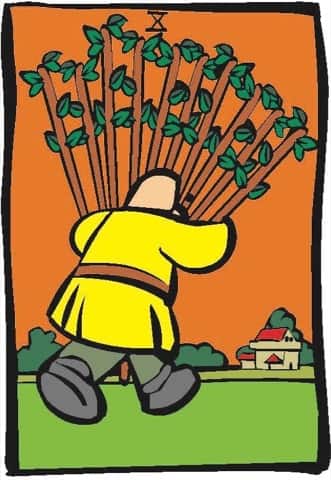
The artist of the the Rider Waite Smith (RWS) deck, Pamela C. Smith, has taken her inspiration for the 10 of Wands from oldest known 78 card Tarot deck's 10 Of Swords. The Sola Busca Tarot depicts a man placing 10 swords in a bag attached to a manger ring on a wall, his body is in the same position with his head down. In 1907, two years prior to the publication of the RWS deck, the British Museum received photographs of the complete Sola Busca tarot deck which they put on display in London where Waite and Smith were based. Many details from this old deck have been re-used in the RWS, the 3 Of Swords being almost identical. This symbolic theme of the collectiveness of the number 10 was passed over for the RWS 10 of Swords in favour of the 10 of Wands but it is worth remembering these alternative interpretations when intuitively feeling for the correct meaning and interpretation of either of these cards. The image depicted in the RWS 10 of Wands often gives an initial impression of a man struggling to pick up and carry 10 long sticks which leads to the common interpretation of being overburdened or having taken on too many projects at the same time.

The 10 of Wands, 10 of Rods or 10 of Batons, is a card of heavy burdens, long term ambitions and large projects. The element here is Fire which relates to energy, drive, home, community and work. The number 10 in numerology, like the 1, is symbolic of something new but different because it is built upon something else, something that already exists.

© Phuture Me Ltd 2010-2019. All rights reserved.

THE PICTORIAL KEY TO THE TAROT

By Arthur Edward Waite (1911)

A man oppressed by the weight of the ten staves which he is carrying. Divinatory Meanings: A card of many significances, and some of the readings cannot be harmonized. I set aside that which connects it with honour and good faith. The chief meaning is oppression simply, but it is also fortune, gain, any kind of success, and then it is the oppression of these things. It is also a card of false-seeming, disguise, perfidy. The place which the figure is approaching may suffer from the rods that he carries. Success is stultified if the Nine of Swords follows, and if it is a question of a lawsuit, there will be certain loss. Reversed: Contrarieties, difficulties, intrigues, and their analogies.

Related Tarot Cards

The Ten of Pentacles Tarot card meaning and interpretation The Ten of Swords Tarot card meaning and interpretation The Ten of Cups Tarot card meaning and interpretation
The Hermit Tarot card meaning and interpretation The Sun Tarot card meaning and interpretation

© Phuture Me Ltd 2019. All rights reserved.

Close

Knight of Pentacles, or Knight of Coins, Tarot card meaning and interpretation

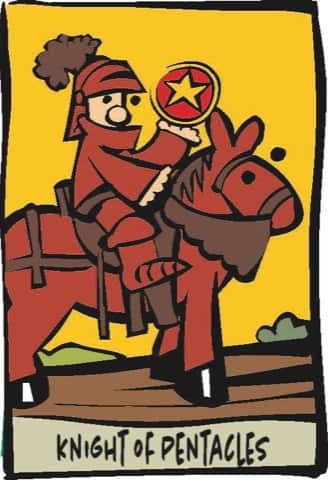
Tarot's Knights, like the Knight of Pentacles, are related to The Chariot. They can be thought of as the Captains of their element, in this case Earth, led by their leader The Charioteer who is warlord of all the elements. As The Chariot is card number 7 of the Major Arcana we can assign any Knight a numerological attribute of 7 by proxy. The numerological traits of the number 7 are rest, inaction, planning, analysing and waiting. A Knight, just like The Chariot, cannot represent attack and should only be defensive. They wear simple, practical, armour without ceremonial, or rank defining, decoration. Helmets, not crowns. Their display is purely one of defending their element.

The Chariot and Knights, with the exception of the Knight of Swords, represent defence. The Rider-Waite-Smith (RWS) Tarot deck emphasised their defensive nature by cladding them in armour. In the older Tarot decks, like the Marseilles, only the Knight of Swords is wearing armour and holding a weapon. The key theme with the Knight of Pentacles is one of being materially defensive. The imagery of the card you are looking at should illustrate the mind set. In both the Marseilles and RWS decks the horse backed knight faces west/right which represents the future. His right hand holds a single pentacle forward in an offering gesture. Just as the Ace of Pentacles signifies a new material investment, or possession, this card does too but with the caveat that it's being done so cautiously.Marseilles Knight of Pentacles Tarot card meaning and interpretation

There are many ways to interpret the Knight of Pentacles. Some examples are:

  • Offering a gift or receiving one with caution. Past negative experiences may be causing this defensive stance. Suspecting that someone is trying to win favour with a gift because they have ulterior motives and being resistant to accepting it.
  • It could be a need to borrow, hire or purchase something. This card maybe advising that due diligence should be applied first, and all options explored, before proceeding.
  • Remember that health is sometimes covered by this elemental domain which is psychical as well as material. The 5 Of Pentacles sometimes points to poor health and illness. The Knight of Pentacles can therefore represent taking health precautions, purchasing protective clothing or just looking after your body.
  • The simplest way to interpret this card is just being careful with your money and not over extending your expenses.

The Knight of Pentacles, also known as the Knight of Coins or Knight of Deniers, could be a young* man who has not reached maturity** yet. His vocation in life could be related to the element earth (farmer, gardener etc) or money, wealth or business (entrepreneur, businessman, accountant, banker etc). The symbolic relationship to this card may not be vocational, it could be a description of his personality. In which case this man will be a cautious person, reliable, grounded, a good negotiator and maybe even has a tendency to be stubborn.

In the Rider-Waite-Smith Tarot The Knight is travelling on a horse from west to east but the horse has stopped. It is important to note these details when divining who the symbology is talking about. This could, for example, mean a young man who is cautiously travelling, or who comes from the west across fertile lands.

Finally, the symbology is never fixed in its interpretation as this card may not represent a person but a situation. For example it could be someone coming to collect or deliver money or news about business, the expense of car repairs or a travel insurance policy.

*the age of this man could be relative to the person the reading is for. He maybe a mature man but a younger man.

**maturity happens between ages 28 to 37, when a man enter's his 2nd numerological life cycle.

© Phuture Me Ltd 2010-2019. All rights reserved.

THE PICTORIAL KEY TO THE TAROT

By Arthur Edward Waite (1911)

He rides a slow, enduring, heavy horse, to which his own aspect corresponds. He exhibits his symbol, but does not look therein. Divinatory Meanings: Utility, serviceableness, interest, responsibility, rectitude-all on the normal and external plane. Reversed: inertia, idleness, repose of that kind, stagnation; also placidity, discouragement, carelessness.

Related Tarot Cards

The Chariot Tarot Card meaning and interpretation Knight of Wands Tarot card meaning and interpretation Knight of Swords Tarot card meaning and interpretation Knight of Cups Tarot card meaning and interpretation

© Phuture Me Ltd 2018. All rights reserved.

Close

Ten of Swords Tarot card meaning and interpretation

In the Suit of Swords there's a gradual build up of stress, worry and problems as the numbers ascend. Beginning with the initial challenge of the Ace of Swords, the attempt at diplomacy in the 2 of Swords, the disappointed and heartache of the 3 of Swords continuing on until reaching a crescendo of mental, sleep depraving, anguish in the 9 of Swords. The scene in the 10 of Swords, which looks like a gruesome murder scene, is one of calm and peace. Whatever your plans were they are well and truly dead. There is a realisation here that no amount of thinking, planning, negotiation or intellectual manoeuvring can take things forward from this point.

The 10 of Swords is a card of total defeat, collapsed plans and failure. The element here is Air which relates to challenges, conflicts and the mental aspects of our lives. The storms on the path of life that we must navigate through. The number 10 reduces in numerology to 1 (1+0). The 10 of Swords, like the Ace of Swords, marks the beginning of new challenges, plans, or ideas. The difference between these cards is that the 10 marks the passing of one cycle and the beginning of a new one. An Ace makes no reference to the past only a completely new beginning. The 10 builds something new upon previous cycles, it is an Ace armed with experience. Seeing this card the message maybe to try again using a new approach with the experience of knowing what does not work.

In the Rider Waite Smith (RWS) deck the background scene is one of calm waters symbolising emotional peace and a dark night sky giving way to breaking day light and dawn symbolising a new beginning. If you go back one card in this suit to the 9 Of Swords you'll see a night time scene and someone who can not quieten their mind and sleep from worry and anxiety. In the scene depicted in the 10 of Swords night is ending, a new day is beginning and the mental fever has broken and passed. As dramatic and unpleasant as this card first appears it also has the positive, comforting, message that the worst is over. Remember that this card, and the Suit of Swords, deals with the mental and intellectual aspects of life therefore its dramatic depiction of a man impaled with ten swords does not refer to anything physical only to something abstract. Even though the imagery of this card would seem to imply Death this is not the case because the 10 is cyclic. You have no choice but to accept defeat, put whatever it was behind you and move on to a new day and new challenges.

© Phuture Me Ltd 2010-2019. All rights reserved.

THE PICTORIAL KEY TO THE TAROT

By Arthur Edward Waite (1911)

A prostrate figure, pierced by all the swords belonging to the card. Divinatory Meanings: Whatsoever is intimated by the design; also pain, affliction, tears, sadness, desolation. It is not especially a card of violent death. Reversed: Advantage, profit, success, favour, but none of these are permanent; also power and authority.

Close

Ace of Pentacles, or Ace of Coins, Tarot card meaning and interpretation

Aces are numerically the lowest ranking card in any deck of cards, playing or tarot. Probably due to modern concept of Aces High, which has been popularised in music, media and card games, we place great value on the ace as it has become a modern symbol of good luck. Before printed playing cards, when dice playing was more common, the 1 represented bad luck due to its low value. In reading tarot it is good practice not to jump to immediate, and literal, conclusions when particular cards appear. A tempered, open minded and intuitive approach should always be taken to all negative cards, and supposedly positive cards, in interpreting their meaning. The Ace of Pentacles is one such card that can inspire excitement at its appearance, supposedly promising a new, unexpected, material endowment. Sometimes it does herald a gift or an unexpected windfall but more often it signifies other aspects of an Ace's symbology.

Material endowments require an initial seed investment to start them off followed by careful cultivation and nurture to keep them growing larger and stronger. The Ace of Pentacles symbolises something materially new, it is like a seed placed in the earth that has the potential to grow into something of greater value. It is not alone in the Suit of Pentacles as a card with a single Pentacle as each character in the court cards holds one. The Page lacks the experience, or responsibility, to handle this new wealth. The Knight guards wealth preventing unnecessary distribution or loss. The Queen uses it to nurture growth through patronage. The King maintains wealth keeping what he has and ensuring healthy, risk free, growth.

Numerology isn't well known or understood but there is no need to explain what the number 1 symbolises to most people. It's the number of a winner, a leader. It is premium and premier. These are the desired traits we all easily associate with 1 but we must remember that 1 is also symbolic of a beginning, a first step in a sequence, cycle or journey. It can also symbolise independence and individualism.

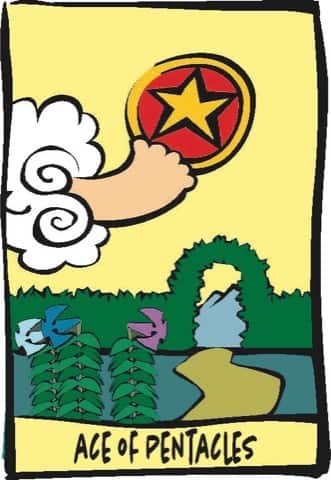
The Rider Waite Smith (RWS) deck added a walled garden, with lilies growing in it, as a background to the Ace of Pentacles and included a hand, holding the pentacle, coming out of a cloud hovering over the ground. The Lily is symbolic of chastity, innocence and purity. The inclusion of the cloud, as the source of the hand, is there to symbolise the divine origin of all things. It serves to remind us of the greatest mystery of all - where does everything come from, and return to, including ourselves?

The Ace of Pentacles can herald a new material endeavour or project rather than simply receiving something unexpectedly. This can be both positive or negative. For example a new investment or job which will take time, and further steps, to realise any gain. Or it could be a new and unexpected expense, or financial commitment, that maybe a one time payment or a cycle of payments. A Tarot deck has five Aces, if you include The Magician from the Major Arcana, but it also has five 10s, including the The Wheel of Fortune. This is an important point to keep in mind as the Ace is symbolic of only a beginning. It does not symbolise completion and achievement because that attribute belongs to 10. In numerology the number 10 reduces to 1 (1+0=1). In the 10 Of Pentacles we see the results of one, or many, completed cycles that are material in nature. The relationships between the Wheel of Fortune, card 10 of the Major Arcana, and the Aces should remind us that each cycle can be different. Some will be rewarding and others difficult as luck depends on the outcome of spinning the wheel of fortune. It's tempting, especially as a beginner, to pull just a single card using Tarot for divination but this runs the risk of "a little knowledge is dangerous". The bigger picture, given by larger spreads, will always help to temper interpretation of cards that roll the dice of luck like Aces.

The Ace of Pentacles, or the Ace of Coins, is traditionally represented as a single pentacle, or coin. It's symbology is simple, it has the element of earth and a numerological value of 1. In numerology the 1 represents both rank and beginning. The Ace of Pentacles could symbolise one's most prized, or valuable, possession e.g. a car, a home etc. As a beginning it could represent a new job, income source or investment.

© Phuture Me Ltd 2010-2018. All rights reserved.

THE PICTORIAL KEY TO THE TAROT

By Arthur Edward Waite (1911)

A hand issuing, as usual, from a cloud holds up a pentacle. Divinatory Meanings: Perfect contentment, felicity, ecstasy; also speedy intelligence; gold. Reversed: The evil side of wealth, bad intelligence; also great riches. In any case it shews prosperity, comfortable material conditions, but whether these are of advantage to the possessor will depend on whether the card is reversed or not.

Related Tarot Cards

Ace of Wands Tarot card meaning and interpretation Ace of Swords Tarot card meaning and interpretation Ace of Cups Tarot card meaning and interpretation
The Magician Tarot card meaning and interpretation The Wheel of Fortune Tarot card meaning and interpretation The Sun Tarot card meaning and interpretation

© Phuture Me Ltd 2018. All rights reserved.

Close

King of Cups Tarot card meaning and interpretation

Court cards, like the King of Cups, are unnumbered which makes using numerology to unlock their basic symbology more challenging. On the surface we have the male ruler of the elemental domain of Water but not much else to go on. We can however link Tarot's Kings to their supreme ruler and card number 4 of the Major Arcana, The Emperor, which would give any King a numerological attribute of 4 by proxy.

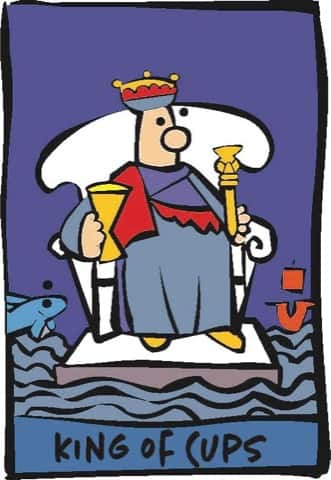
The same element and numerology can be found in the 4 of Cups. The Rider Waite Smith (RWS) deck first illustrated the 4 of Cups as a young male, arms and legs crossed defensively, sitting under a tree looking petulantly at 3 cups before him. Like the Ace of Cups there is a cloud with a hand offering a new, 4th, cup. four of Cups Tarot card meaning and interpretation Perhaps past relationship issues have left this emotionally inexperienced youth guarded about engaging in any new relationships. The number 4 is symbolic of a rigid structure which is static and safe but its unchanging form can be also be stagnant and boring. In the 4 of Cups we see someone who is unwilling to accept the next emotional step on from the care free 3 Of Cups to a stable and lasting relationship offered by the 4th cup. The RWS deck's King of Cups faces front with his head turned to the right, or east, representing the future. He sits in a safe and secure place on a throne on a solid, square, rock surrounded by a rough sea. His right foot forward almost as if he's prepared to "dip a toe in the water". The attitudes displayed in these two cards are contrastingly different with the youth reluctant to engage with 4 cups of water and the King unafraid of a vast, stormy sea.

The key difference between the youth in the 4 of Cups and the King of Cups is emotional maturity. The King has the benefit of experience and is unafraid of the wild and deep emotional waters of life. He represents an emotionally experienced, well balanced and socially confident person. A shoulder to cry on, a patient listener and sympathetic ear. Sensitive and understanding this person would make a good counsellor. Unlike the youth this King is not afraid of emotional commitment and long term, lasting, relationships. This is what he is good at and he represents someone who would make a great husband, partner, father or friend.

The King of Cups may represent a mature* man whose vocation in life is related to the element of water (a fisherman, sailor, plumber etc.) or emotions (a counsellor, psychologist, actor etc). The symbolic relationship to this card may not be vocational. It could be a description of his personality. In this case this man will be a sensitive, caring, patient and perhaps even a gullible or innocent man. Sometimes it refers to a man who has feminine qualities or is highly intuitive or even psychic.

*maturity happens between ages 28 to 37, when a man enter's his 2nd numerological life cycle.

© Phuture Me Ltd 2010-2019. All rights reserved.

THE PICTORIAL KEY TO THE TAROT

By Arthur Edward Waite (1911)

He holds a short sceptre in his left hand and a great cup in his right; his throne is set upon the sea; on one side a ship is riding and on the other a dolphin is leaping. The implicit is that the Sign of the Cup naturally refers to water, which appears in all the court cards. Divinatory Meanings: Fair man, man of business, law, or divinity; responsible, disposed to oblige the Querent; also equity, art and science, including those who profess science, law and art; creative intelligence. Reversed: Dishonest, double-dealing man; roguery, exaction, injustice, vice, scandal, pillage, considerable loss.

Related Tarot Cards

The Emperor Tarot card meaning and interpretation King of Wands Tarot card meaning and interpretation King of Pentacles Tarot card meaning and interpretation King of Swords Tarot card meaning and interpretation

© Phuture Me Ltd 2018. All rights reserved.

Close

The World Tarot card meaning and interpretation

In beginning to understand the meaning of this card let us begin with its name. The names assigned to some cards in the tarot deck can often mislead, or misdirect, from what the true meaning of the card is. The name is probably the place we start from before we even begin to take in what the picture is telling us. The Fool automatically makes us judgemental towards its character. The Lovers suggests a sexual context when it is really about choices and irreversible decisions. So begin by asking yourself what does the word World mean to you? Do you think of planet Earth as the World? Or do you consider it to encompass the entire Universe? We talk about heaven and earth as the two distinct planes of the spiritual and material. Do you consider The World to embody the latter or both? The word comes from the old German meaning "Age of Man" or "Domain of Man". However the Latin equivalent mundus, from which this Tarot card's original Italian name Il Mondo comes from, means "clean, elegant". The Latin word borrowed from the Greek word Cosmos meaning "orderly arrangement" the opposite, in Greek, being "Chaos". It was Pythagoras who first used the word Cosmos to describe the Universe.

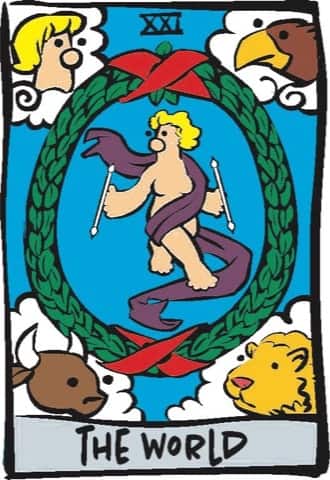
Some modern decks have incorporated, in the background of this card, an image of planet Earth. The Rider Waite Smith (RWS) deck changed most of the cards in Tarot but not this one, A.E Waite described the card as "unchangeable". Traditional tarot decks, including the RWS, depict this card as a woman standing, or dancing, inside a oval laurel which symbolises a Yoni, womb or female reproductive organs. This detail may suggest a meaning of birth, re-birth or fertility.

The World and The Empress are connected through numerology as both are 3s. As card 21 of the Major Arcana its numerology is 3 when 21 is reduced (2 + 1 = 3). Both cards relate to fertility and nurturing but with The World this isn't so focused on the physical and material as The Empress, but on the spiritual and divine. There is one other 3 in the Major Arcana which shares a visual detail. Notice in the traditional depictions, including the RWS deck, that the woman in The World has her left leg crossed behind her right leg. This same detail is found in card 12 of the Major Arcana The Hanged Man. This crossed legs is an ancient symbol known as a fylfot in the West and swastika in the East. This is not a symbol of hate, as it was mis-used in the middle of the 20th century, but an ancient and sacred symbol of the eternal wheel of life. In India it is a symbol of health, luck, success and prosperity and in Europe it can be found in the stained glass windows of some churches. If The World represents a womb and birthing then The Hanged Man would represent a child coming head first from it. Both cards together would be a good omen for an expectant mother worried about the birth.

In the RWS deck the character's body indicates motion to the right, or west, symbolising heading in the right direction. Compare this to The Fool, in the same RWS deck, who is heading in the wrong direction. The World character looks over her shoulder, in a mirror image of the thief in the 7 of Swords. The thief is heading in the wrong direction looking over his shoulder towards the future and correct direction. The World character is looking back at the past, at the road she has travelled. This is an important detail as The World often symbolises being in a better position to make decisions with the benefit of experience. If it is the final outcome card, in a tarot spread, it could mean that you may change your opinion on something, or someone, when you reach the end of that cycle or situation. Like climbing to the top of a hill or mountain, to get a better view of the surrounding landscape, your situation needs you to be in a better position to fully understand it.

The final visual detail in The World is a biblical one. In each corner of the card, seen in the traditional decks and the RWS, is a face of the "four living creatures" Ezekiel describes in the old testament (Ezekiel 1:1-10) . They are also described in John's vision in Revelation (4:6–8) as sitting around the throne in heaven. These four characters are also found in the The Wheel of Fortune card of the RWS deck. Some consider The Fool to represent our struggles through life, and the many trials we must learn from, culminating in a final Judgement before attaining heaven, ascension, enlightenment or re-birth represented by The World. In a non-spiritual interpretation of this card it may mean successfully reaching a finishing line and completing something.

"The Lama Ngawang Kalzang had been meditating for twelve years in various caves and retreats in the wilderness of the mountains of Southern Tibet ..... The world had forgotten him, and he had forgotten the world. This was not the outcome of indifference on his part but, on the contrary, because he had ceased to make a distinction between himself and the world. What actually he had forgotten was not the world but his own self, because the ‘world’ is something that exists only in contrast to one’s own ego." - from "The Way of the White Clouds" by Anagarika Govinda

The World can symbolises completion, accomplishment, victory, travel overseas and expansion of horizons. A happy card to find in any spread it is the final card of the major arcana and therefore symbolic of the end of the journey of The Fool through all 21 major cards. It represents an ultimate goal achieved, a pinnacle in life. In its simplest interpretation this card may point to travel abroad to other continents, environmentalism or world affairs, or even simply travel documents such as a passport. As a person it could represent a foreigner. This card also symbolises fertility and reproductive organs.

"To see the world in a grain of sand
And Heaven in a wild flower
Hold infinity in the palm of your hand
And eternity in an hour."
- William Blake

© Phuture Me Ltd 2010-2019. All rights reserved.

THE PICTORIAL KEY TO THE TAROT

By Arthur Edward Waite (1911)

As this final message of the Major Trumps is unchanged--and indeed unchangeable--in respect of its design, it has been partly described already regarding its deeper sense. It represents also the perfection and end of the Cosmos, the secret which is within it, the rapture of the universe when it understands itself in God. It is further the state of the soul in the consciousness of Divine Vision, reflected from the self-knowing spirit. But these meanings are without prejudice to that which I have said concerning it on the material side.

It has more than one message on the macrocosmic side and is, for example, the state of the restored world when the law of manifestation shall have been carried to the highest degree of natural perfection. But it is perhaps more especially a story of the past, referring to that day when all was declared to be good, when the morning stars sang together and all the Sons of God shouted for joy. One of the worst explanations concerning it is that the figure symbolizes the Magus when he has reached the highest degree of initiation; another account says that it represents the absolute, which is ridiculous. The figure has been said to stand for Truth, which is, however, more properly allocated to the seventeenth card. Lastly, it has been called the Crown of the Magi.

Related Tarot Cards

The Fool Tarot card meaning and interpretation The Empress Tarot card meaning and interpretation The Wheel of Fortune Tarot card meaning and interpretation The Hanged Man Tarot card meaning and interpretation

© Phuture Me Ltd 2019. All rights reserved.

Close

Knight of Wands, Rods or Batons, Tarot card meaning and interpretation

Tarot's Knights, like the Knight of Wands, are related to The Chariot They can be thought of as the Captains of their element, in this case Fire, led by their leader The Charioteer who is warlord of all the elements. As The Chariot is card number 7 of the Major Arcana we can assign any Knight a numerological attribute of 7 by proxy. The numerological traits of the number 7 are rest, inaction, planning, analysing and waiting. A Knight, just like The Chariot, cannot represent attack and should only be defensive. They wear simple, practical, armour without ceremonial, or rank defining, decoration. Helmets, not crowns. Their display is purely one of defending their element.

The Chariot and Knights, with the exception of the Knight of Swords, represent defence. The Rider-Waite-Smith (RWS) Tarot deck emphasised their defensive nature by cladding them in armour. In the older Tarot decks, like the Marseilles, only the Knight of Swords is wearing armour and holding a weapon. The key theme with the Knight of Wands is one of defending ones work or home. The imagery of the card you are looking at should illustrate the mind set. In both the Marseilles and RWS decks the horse backed knight is heading left/east which represents the past. His right hand holds a single wand upright, not forward in an attacking gesture the Knight of Swords. Just as the Ace of Wands signifies a new project, job or home, this card does too but with the caveat that it's being done with caution or resistance.

The Marseilles decks usually depict both the horse and rider heading left/east (the past) but both man and steed are looking backwards west/right (the future). This may indicate a reluctance to engage with something that can be seen approaching from the future. The Rider-Waite-Smith (RWS) Deck changed this feature so both man and horse are facing in the direction they are travelling. In addition to this change the horse is rearing up with it's master pulling so tightly on it's reins that it's head is pulled as far back as it will go. The detail is worth noting as it indicates a need to control power and direction. The Knight wants to remain stationary, or is reluctant to head in that direction, but what is under him is bursting with energy and raring to go. Heading backwards, towards the past, may be taken as the wrong direction. The element of fire can represent the physical energy that one would apply to work and projects but it is also about passion, energy and drive which, if uncontrolled, can be damaging and dangerous. The Marseilles Knight maybe symbolising a reluctance to take on a job or apply ones efforts to something. The RWS Knight may also symbolise keeping control of a project and not allowing other forces to take it in the wrong direction.Marseilles Knight of Wands Tarot card meaning and interpretation

Returning to the theme of defence that runs within the Knight and the Chariot this Knight could signify a need to take defensive measure at home or in the work place. For example home improvements or repairs that maybe needed to prevent damage from the elements. Another example would be guarding, or being defensive about, ones position, or project at work.

The Knight of Wands, also known as the Knight of Rods or Knight of Batons, could be a young* man who has not reached maturity** yet. His vocation in life could be related to the element of fire, home or construction (for example a fire fighter, an architect, an engineer, a carpenter or joiner). The symbolic relationship to this card may not be vocational, it could be a description of his personality. In which case this youth may be passionate, fiery or changeable. He could be someone who prefers to live in the countryside than a town or city. Someone who has a love of nature.

*the age of this man could be relative to the person the reading is for. He maybe a mature man but a younger man.

**maturity happens between ages 28 to 37, when a man enter's his 2nd numerological life cycle.

© Phuture Me Ltd 2010-2019. All rights reserved.

THE PICTORIAL KEY TO THE TAROT

By Arthur Edward Waite (1911)

He is shewn as if upon a journey, armed with a short wand, and although mailed is not on a warlike errand. He is passing mounds or pyramids. The motion of the horse is a key to the character of its rider, and suggests the precipitate mood, or things connected therewith. Divinatory Meanings: Departure, absence, flight, emigration. A dark young man, friendly. Change of residence. Reversed: Rupture, division, interruption, discord.

Related Tarot Cards

The Chariot Tarot card meaning and interpretation Knight of Pentacles Tarot card meaning and interpretation Knight of Swords Tarot card meaning and interpretation Knight of Cups Tarot card meaning and interpretation

© Phuture Me Ltd 2018. All rights reserved.

Free AI Tarot Reading. Sample the Future!

Artificial Intelligence reads Tarot Cards so well you have to see it to believe it!
We'd love for you to try it for FREE and see for yourself why this excites us.

TRY IT NOW

Free AI Tarot Reading

If you registered on our App, and don't have a username, use your email address.


Forgot your password?
Forgot your username?
Create an account